



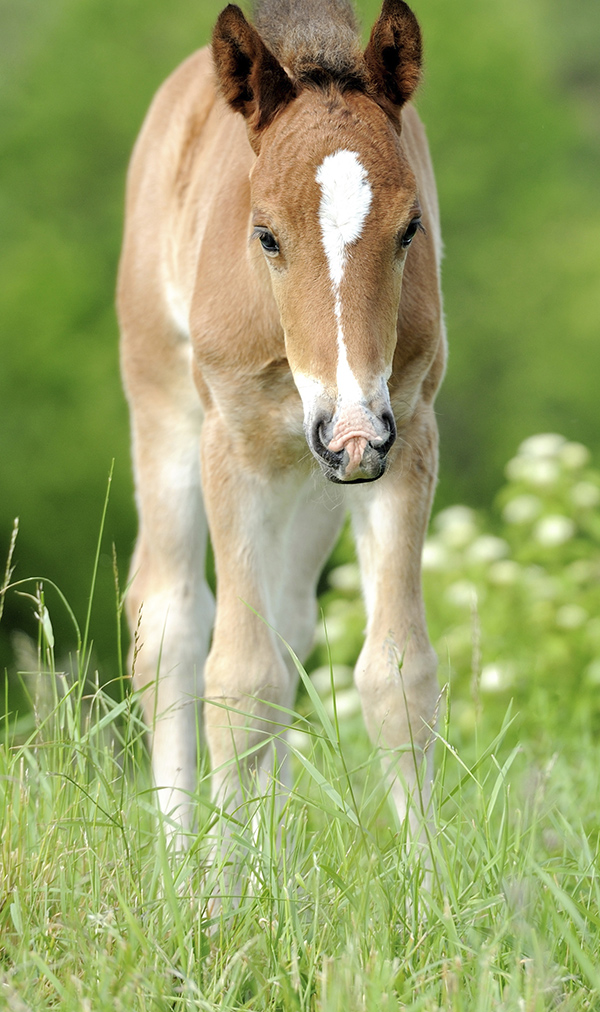
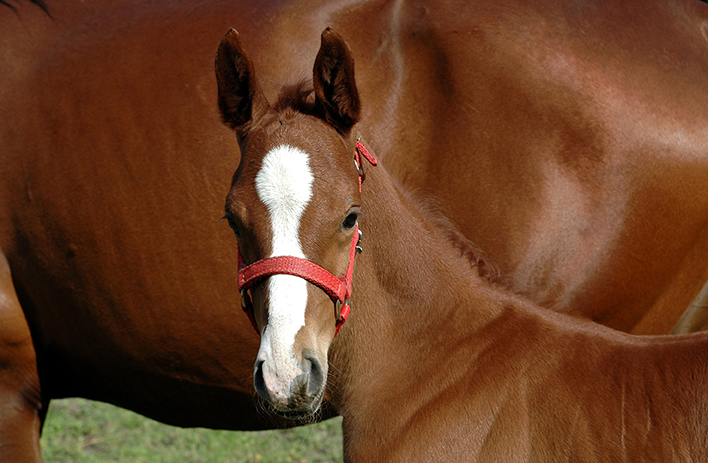
The male parent of a horse, a stallion, is commonly known as the sire and the female parent, the mare, is called the dam. Both are genetically important, as each parent provides half of the genetic makeup of the ensuing offspring, called a foal. Contrary to popular misuse, "colt" refers to a young male horse only; "filly" is a young female. Though many horse owners may simply breed a family mare to a local stallion in order to produce a companion animal, most professional breeders use selective breeding to produce individuals of a given phenotype, or breed. Alternatively, a breeder could, using individuals of differing phenotypes, create a new breed with specific characteristics.
A horse is "bred" where it is foaled (born). Thus a foal conceived in England but foaled in the United States is regarded as being bred in the US. In some cases, most notably in the Thoroughbred breeding industry, American- and Canadian-bred horses may also be described by the state or province in which they are foaled. Some breeds denote the country, or state, where conception took place as the origin of the foal.
Similarly, the "breeder", is the person who owned or leased the mare at the time of foaling. That individual may not have had anything to do with the mating of the mare. It is important to review each breed registry's rules to determine which applies to any specific foal.
In the horse breeding industry, the term "half-brother" or "half-sister" only describes horses which have the same dam, but different sires. Horses with the same sire but different dams are simply said to be "by the same sire", and no sibling relationship is implied. "Full" (or "own") siblings have both the same dam and the same sire. The terms paternal half-sibling, and maternal half-sibling are also often used. Three-quarter siblings are horses out of the same dam, and are by sires that are either half-brothers (i.e. same dam) or who are by the same sire.
Thoroughbreds and Arabians are also classified through the "distaff" or direct female line, known as their "family" or "tail female" line, tracing back to their taproot foundation bloodstock or the beginning of their respective stud books. The female line of descent always appears at the bottom of a tabulated pedigree and is therefore often known as the bottom line. In addition, the maternal grandfather of a horse has a special term: damsire.
"Linebreeding" technically is the duplication of fourth generation or more distant ancestors. However, the term is often used more loosely, describing horses with duplication of ancestors closer than the fourth generation. It also is sometimes used as a euphemism for the practice of inbreeding, a practice that is generally frowned upon by horse breeders, though used by some in an attempt to fix certain traits.
Breeding - Click the Name
Breeding - General Information
Pedigree Theories and Selection Techniques: Nick Ratings
Nick Ratings (or why nick ratings are the bane of my existence), by Anne Peters
It's important that people understand what a nick is, and the difference between a nick and a nick rating. Nicks are a fact, but nick ratings are a statistic, and we all know statistics can be very misleading. Unfortunately, ratings are what people want nowdays because it's easier to read a score and blindly accept it, than to reason out the intricate process of properly mating your mare.
The word "nick" has become distorted in breeding jargon due to the proliferation of the ratings, so that many people have come to use it as a verb. "What stallions nick with my mare?" or "I want you to nick my mares." When I hear that, my skin crawls. The nick ratings have created this quick and dirty method of matching stallions and mares to the demise of well rounded matings.
I don't think this is what the creators of either popular nick rating system intended, but that's what has happened. Nick ratings have done more to take down real mating analysis than anything I've ever seen.
What is a nick? In my article "Nicks or Not," I explain that a nick is a real live genetic term describing a cross of two bloodlines that produces superior results a surprising amount of the time. It's not guaranteed, but it has a serious track record. The A.P. Indy/Mr. Prospector cross is a good modern example.
Some of A.P. Indy's most important offspring are the result of this nick including Horse of the Year Mineshaft, and his good sire sons Pulpit and Malibu Moon, all sons of A.P. Indy out of mares sired by Mr. Prospector. That's a nick. It's rare, and it's very specific.
A.P. Indy on a mare by Mr. Prospector represents a very specific pedigree alignment accounting for 75% of the same pedigree on paper. If the mare is not by Mr. Prospector, we're not talking about the same nick. Bernardini is by A.P. Indy and out of a mare by Quiet American.
Quiet American, by Fappiano, by Mr. Prospector, is a male line grandson of Mr. Prospector. It's a similar cross, but technically, it's not the same nick, because Mr. Prospector's influence is diluted 2 generations further back.
Since we know full siblings in actuality share only about 50% of their genes, theoretically, the chances of genetic similarity based on three-quarter relatives, relatives with 75% similar parentage, are half of that, or 37.5%.
A.P. Indy crossed with a mare by a son of Mr. Prospector reduces the influence of Mr. Prospector by even more, down to 62.5% on paper, or 31.25% in terms closer to probability. The further back the key ancestor is along the mare's male line, it's potential influence decreases dramatically every generation.
Here are some of the qualities of a good racing Quarter Horse breeding farm:
- Location: The farm should be located in an area with a mild climate and good soil conditions. The climate should be warm enough to allow the horses to breed year-round, but not too hot or humid. The soil should be well-drained and free of toxins.
- Facilities: The farm should have a variety of facilities to accommodate the needs of the horses, including a breeding barn, a foaling barn, a quarantine barn, and a turnout area. The breeding barn should be spacious and well-ventilated. The foaling barn should be clean and comfortable. The quarantine barn should be isolated from the other horses to prevent the spread of disease. The turnout area should be large enough for the horses to exercise and socialize.
- Staff: The farm should have a team of experienced and knowledgeable staff who are dedicated to the care and well-being of the horses. The staff should be familiar with the needs of Quarter Horses and be able to provide them with the highest quality of care.
- Horses: The farm should have a good selection of Quarter Horses that are suitable for breeding. The horses should be healthy, sound, and have the potential to produce foals that are competitive in racing.
- Program: The farm should have a well-structured program that will help the horses reach their full potential. The program should include a variety of breeding practices, such as artificial insemination and embryo transfer, to ensure that the horses are bred to the best possible partners.
In addition to these qualities, a good racing Quarter Horse breeding farm should also be committed to the ethical treatment of animals. The farm should have a strong welfare program that ensures the horses are well-cared for and have a good quality of life.
Here are some additional things to consider when choosing a racing Quarter Horse breeding farm:
- The farm's reputation: Do your research and find out what other people have to say about the farm. Talk to other owners, trainers, and veterinarians who have experience with the farm.
- The farm's financial stability: Make sure the farm is financially stable and has the resources to care for the horses.
- The farm's breeding program: If you are interested in breeding Quarter Horses, find out about the farm's breeding program.
- The farm's location: Consider the location of the farm in terms of your own needs and preferences. Do you want to be close to a racetrack or do you prefer a more remote location?
Choosing a good racing Quarter Horse breeding farm is an important decision. By considering the qualities listed above, you can be sure to find a farm that will provide your horses with the best possible care and help them reach their full potential.
Breeding - Quarter Horse - United States | International (Click here)
Breeding - Quarter Horse - International
Here are some of the qualities of a good racing Standardbred breeding farm:
- Location: The farm should be located in an area with a mild climate and good soil conditions. The climate should be warm enough to allow the horses to breed year-round, but not too hot or humid. The soil should be well-drained and free of toxins.
- Facilities: The farm should have a variety of facilities to accommodate the needs of the horses, including a breeding shed, a foaling barn, a yearling barn, and a turnout area. The breeding shed should be well-ventilated and have plenty of space for the horses to breed. The foaling barn should be clean and well-maintained to ensure the foals have a safe and comfortable environment. The yearling barn should be spacious and have plenty of exercise space for the yearlings. The turnout area should be large enough for the horses to exercise and socialize.
- Staff: The farm should have a team of experienced and knowledgeable staff who are dedicated to the care and well-being of the horses. The staff should be familiar with the needs of Standardbreds and be able to provide them with the highest quality of care.
- Horses: The farm should have a good selection of Standardbreds that are suitable for breeding. The horses should be healthy, sound, and have the potential to produce successful racehorses.
- Breeding program: The farm should have a well-structured breeding program that will help the horses reach their full potential. The program should include a variety of breeding practices to ensure the horses are bred to the best possible partners.
In addition to these qualities, a good racing Standardbred breeding farm should also be committed to the ethical treatment of animals. The farm should have a strong welfare program that ensures the horses are well-cared for and have a good quality of life.
Here are some additional things to consider when choosing a racing Standardbred breeding farm:
- The farm's reputation: Do your research and find out what other people have to say about the farm. Talk to other owners, breeders, and veterinarians who have experience with the farm.
- The farm's financial stability: Make sure the farm is financially stable and has the resources to care for the horses.
- The farm's breeding program: If you are interested in breeding Standardbreds, find out about the farm's breeding program.
- The farm's location: Consider the location of the farm in terms of your own needs and preferences. Do you want to be close to a racetrack or do you prefer a more remote location?
Choosing a good racing Standardbred breeding farm is an important decision. By considering the qualities listed above, you can be sure to find a farm that will provide your horses with the best possible care and help them reach their full potential.
Breeding - Standardbred - United States | International (Click here)
New JerseyNew YorkOhioPennsylvania
Breeding - Standardbred - International
Thoroughbred breeding is a meticulous and time-honored practice that has been refined over centuries to produce horses of exceptional speed, stamina, and athleticism. These prized animals are the foundation of the global horseracing industry, captivating audiences with their thrilling performances on the track.
The origins of Thoroughbred breeding can be traced back to 18th-century England, where a handful of imported Oriental stallions were crossed with native English mares. These matings resulted in a new breed of horses known for their unmatched speed and agility, quickly gaining popularity among the English aristocracy.
Over time, Thoroughbred breeding became a highly specialized field, with breeders carefully selecting stallions and mares based on their pedigrees, performance records, and physical characteristics. The goal was to produce offspring that inherited the desirable traits of their ancestors, leading to a continuous improvement in the breed's overall quality.
Today, Thoroughbred breeding is a global enterprise, with breeding farms located in countries across the world. Breeders meticulously study pedigrees, utilizing complex inbreeding and outcrossing strategies to enhance the breed's genetic potential. They also employ advanced technologies, such as DNA testing, to better understand the genetic makeup of their horses.
The breeding process is a delicate balance of art and science. Breeders must consider a multitude of factors, including the horses' temperaments, conformation, and health. They must also navigate the unpredictable nature of genetics, as there is no guarantee that the desired traits will be passed down to the offspring.
Despite the challenges, Thoroughbred breeding remains a passionate pursuit for breeders worldwide. The rewards are significant, as successful breeding programs can produce horses that command top prices and achieve legendary status on the racetrack.
Please note that breeding Thoroughbreds is only done with a "live cover" and no artificial insemination as practiced in other breeds.
Here are some key principles that guide Thoroughbred breeding:
- Pedigree Analysis: Breeders carefully study the pedigrees of potential stallions and mares, tracing their lineages back several generations. They look for ancestors with proven performance records and desirable traits, such as speed, stamina, and soundness.
- Matching Traits: Breeders aim to match stallions and mares that complement each other's strengths and weaknesses. They consider factors such as temperament, conformation, and racing style to produce offspring with a well-rounded set of traits.
- Outcrossing: Breeders use outcrossing to introduce new genetic material and genetic diversity.
- Selection and Retaining: Breeders carefully evaluate foals based on their conformation, temperament, and early training progress. They selectively retain those that demonstrate the most promise for racing or breeding, while repositioning those that do not meet their standards by using them for riding, show, or sport horses.
- Nurture and Management: Proper management and care are essential for the successful development of Thoroughbreds. Breeders provide foals with a nurturing environment, ensuring they receive adequate nutrition, exercise, and veterinary care.
- Performance Evaluation: Breeders closely monitor the performance of their horses, both in training and on the racetrack. They use this information to guide future breeding decisions and evaluate the effectiveness of their breeding strategies.
- Continuous Improvement: Thoroughbred breeding is an ongoing process of refinement and improvement. Breeders constantly seek new knowledge and techniques to enhance the breed's overall quality and maintain its dominance in the world of horse racing.
 W9H Ladytown Business Park, Naas, Co. Kildare, Ireland
ph: +353 45 40 7040
Email: info@equilume.com


Equilume Performance Lighting is a unique system that comprises smart Stable Lights and mobile Light Masks designed to maximize health, performance and breeding efficiency. This system harnesses all the benefits of natural daylight for the stabled horse and permits continued exposure to optimum lighting when travelling or at pasture.
 281 Burke Road, Stillwater, NY 12170
ph: (518) 584-1515
Email: Rick Burke – Owner – rick@irishhillcenturyfarm.com
Irish Hill Century Farm is a full care thoroughbred boarding facility, raising world class New York Bred racehorses.
Breeding - Thoroughbred - United States | International (Click here)
Breeding - Thoroughbred - International
Breeding for the Next Champion: 6 Important Considerations for Broodmares
The racing career of Thoroughbred mare, Miss Hockaday, was an immediate success, with career earnings amounting to nearly $262,000, spanning across Oklahoma, Texas, Arkansas and Iowa.
With a champion bloodline harkening to Thoroughbred greats like Seattle Slew and Northern Dancer, owner-trainer, husband-and-wife duo, Jearl (Ace) and Randy Hare, decided her second career would be as a broodmare, continuing on her legacy.
“To see Miss Hockaday’s racing success, and to continue her on as a broodmare, was amazing,” said Randy Hare, co-owner of Hare Racing Stables in Oklahoma City. “She ran a lot of races and beat a lot of great horses. With such high earnings, we only paid $800 for her. It was a very exciting time, and she retired from racing completely sound.”
With her success on the track, it was a paramount decision to select the best possible sire for Miss Hockaday’s first foal.
“Living in Oklahoma, we don’t have a large pool of premier stallions to choose from,” said Hare. “I got her to the best stallion I could, and that was in Kentucky.”
Miss Hockaday was bred to a leading sire, Shackleford, who after retiring in 2012 with $3,090,101 in earnings, cashed in with an initial stud fee of $20,000. The foal, Hareraising, was sold at Keeneland and soon embarked on her racing career.
A mare’s health leading up to breeding is critical for the success of conception, as well as a healthy foal.
Consider These 6 Important Factors for Broodmares and Successful Breeding
- Suppress estrus for improved fertility with Regu-Mate®, Altren® Or Ovamed®.
Estrus suppression will help you predict estrus, as well as improve a mare’s fertility. Regu-Mate facilitates breeding earlier in the season by helping transitional mares cycle regularly. Scheduled breeding with Regu-Mate helps breeding barns manage costs of shipped semen, reduce number of stallion collections needed and schedule the estrous cycles of donor and recipient mares for embryo transplants. By administering Regu-Mate or Ovamed®, mares will return to estrus within five days following treatment. - Ensure mares are at a healthy weight.
Mares should enter the breeding season fit and gaining weight for better chances of successful conception, according to the American Association of Equine Practitioners (AAEP). - Eliminate stress as much as possible.
Stress can cause a mare’s level of Progesterone to drop. This hormone is critical to maintain pregnancy. Illness can cause the mare's system to secrete prostaglandins, which may cause foal loss (commonly referred to as abortion), according to the AAEP. - Maintain current vaccinations.
Protect against abortions in pregnant mares through vaccinations against Eastern and Western encephalomyelitis, West Nile virus, influenza and tetanus at the beginning of pregnancy. Administer booster vaccinations one month before foaling to increase the antibody level in the mare's colostrum to help protect the newborn foal from disease risk. The AAEP also recommends mares be vaccinated against equine rhinopneumonitis at five, seven and nine months' gestation. - Protect the mare and foal from parasites.
As the mare is the primary source for her foal’s parasite risk, it is important for her to be on a safe and effective deworming schedule, with guidance on frequency and timing provided by your veterinarian. - Ensure nutritional needs are met.
As the foal continues to grow, especially during the last four months of pregnancy, a mare’s energy needs will increase. Provide enough quality forage and grain to meet these heightened energy requirements. When it comes time for your mare’s big day, make sure you have everything needed with this Professional Foaling Kit.
Continue on the legacy. Ensure successful conception through excellent broodmare health and these proven solutions for improved fertility, Regu-Mate and Ovamed.
All photographs and images courtesy of Valley Vet.
This article originally appeared on Valley Vet and is published here with permission. Valley Vet Supply was founded in 1985 by veterinarians for people just like you - people who want the very best for their four-legged friends and livestock.
There are more informative articles in our section on Health & Education.