



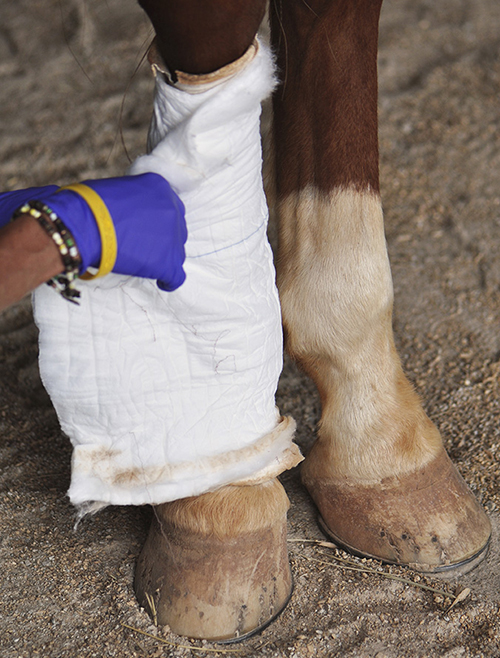
Therapy can help horses in a number of ways, including:
- Recovering from injuries: Physical therapy can help horses to recover from a variety of injuries, such as fractures, muscle strains, and tendon tears. Physical therapy can help to improve range of motion, reduce pain, and strengthen muscles.
- Improving performance: Physical therapy can also be used to improve a horse's performance. For example, physical therapy can help to improve a horse's cardiovascular health, muscle strength, and flexibility.
- Preventing injuries: Physical therapy can also be used to help prevent injuries in horses. For example, physical therapy can help to strengthen muscles and improve balance, which can help to reduce the risk of falls and other injuries.
Here are some specific examples of how physical therapy can be used to help horses:
- A horse with a fractured leg may use physical therapy to improve range of motion in the leg and strengthen the muscles around the joint.
- A horse with a muscle strain may use physical therapy to reduce pain and inflammation in the muscle.
- A horse with a tendon tear may use physical therapy to strengthen the tendon and prevent further injury.
- A racehorse may use physical therapy to improve its cardiovascular health and muscle strength.
- A horse that is prone to falling may use physical therapy to strengthen its muscles and improve its balance.
Physical therapy can be performed by a qualified equine physical therapist. Equine physical therapists use a variety of techniques, such as massage, therapeutic exercise, and electrotherapy, to help horses recover from injuries, improve their performance, and prevent future injuries.
If you are considering physical therapy for your horse, be sure to talk to your veterinarian. They can help you to determine if physical therapy is right for your horse and can recommend a qualified equine therapist.
Featured Listings: Therapeutic Products
 W9H Ladytown Business Park, Naas, Co. Kildare, Ireland
ph: +353 45 40 7040
Email: info@equilume.com


Equilume Performance Lighting is a unique system that comprises smart Stable Lights and mobile Light Masks designed to maximize health, performance and breeding efficiency. This system harnesses all the benefits of natural daylight for the stabled horse and permits continued exposure to optimum lighting when travelling or at pasture.
 9791 NW 160th Street, Reddick, FL 32686
ph: (352) 362-0274
Email: microlief@gmail.com
Microlief®, equine microcurrent therapy, promotes optimal equine health and performance. Microlief® relieves pain and speeds up injury healing.
 Email: questions@organicanaturals.com


The natural medicine company that's all about science! Support your equine with this full spectrum CBD veterinary formula created specifically for horses large and small. A coconut oil-based CBD carrier allows for easy digestion and the highest bioavailability of Cannabinoids.
Therapy
Deworming Medications, Residual Time, and Egg Reappearance
Horsemen’s Laboratory was recently asked how long does deworming medication stay in a horse’s body (residual time)? This question has stimulated a lot of discussion about deworming medications. To answer this question I thought it was best to first discuss the different dewormers according to class of dewormers, based on their chemical make up and mode of action.
Macrocylic Lactones are the only dewormers that are absorbed from the gut into the tissue of the horse when given at the normally recommended dosage. They appear to be the only dewormers that remain in the body for any length of time when given at the normally recommended dosages.
Benzimidazoles may be absorbed when given at higher than the recommended dosage such as when fenbendazole is given for 5 days in a row. The 3 classes of drugs are listed below according to when they first became available for use as deworming medications for horses in the United States.
- Benzimidazoles 1960’s
- Pyrimidines 1970’s
- Macrocylic Lactones 1990’s
No new dewormers have been brought to market for horses since the 1990’s and no new ones appear to be likely in the near future, therefore, every effort must be taken to slow the development of resistance to the drugs we have.
Benzimidazoles
Action, to interfere with energy metabolism at the cellular level
- Thiabendazole
- Cambendazole
- Oxfendazole
- Mebendazole
- Fenbendazole**
- Oxibendazole*
** May have most resistance in worms—especially small strongyles
Pyrimidines
Causes rapid, spastic paralysis of a worm.
- Pyrantel pamoate International
- Pyrantel tatrate* North America daily dewormer
- Pyrantel embonate Europe
- Morantel tartrate Australia
Macrocylic Lactones
This group is made up of both antibiotics and antiparasitics. Causes flaccid paralysis that interferes with ingestion of nutrients by the worms.
Equine 2 sub groups:
- Ivermectin
- Ivermectin
- Abamectin
- Milemycin
- Moxidectin (Quest)
Each class of drug is named for its chemical make up, which is beyond the scope of this discussion. A couple of definitions are in order to continue this discussion.
- Residual time: is the length of time from when a drug is given until when it is no longer measureable in the body, generally measured in hours or days depending on the drug.
- Drug ½ life: the length of time it takes for ½ the dose of a drug to be eliminated from the body (may be relative to the residual time).
- ERP (egg reappearance period): is defined as the time between when a horse is dewormed and when the worm egg count reaches a preset level (often what it was before being dewormed).
So to answer the question, how long does a dewormer stay in the horse’s body? Since there are only 2 drugs, Ivermectin and Moxidectin, which are absorbed into the body when given at normally recommended dosage, they will be compared here.
Moxidectin and Ivermectin when given at recommended dosage
| IVM | MOX | |
| Dose (mg/kg) | 0.2 | 0.4 |
| Cmax (g/ml plasma) | 44.0 (+/- 23.1) | 70.4(+/-10.7) |
| Tmax (day) | .38 (+/-.24) | .37((+/-19) |
| ½ life (days) | 4.25(+/-.29) | 23.11(+/-11) |
| AUC 0-T (g/day/ml) | 132.7(+/-47.3 | 363.6(+/-66) |
| Cmax= Maximum concentration | Tmax =time for maximum concentration | |
| T1/2= Terminal half-life | AUC=Area Under the concentration vs. time Curve | |
The above chart indicates that both Ivermectin and Moxidectin are absorbed in about 9 hours to a maximum plasma level of 44g and 70.4g respectively. The ½ life of Ivermectin and Moxidectin was 4.25days and 23.11 days respectively indicating that Moxidectin is retained much longer than Ivermectin.
The reason for this is that Moxidectin is taken up by fat issue and then is slowly reabsorbed and goes back into the GI track and is excreted. This factor is also credited for the results listed in the following chart. Moxidectin is also more effective against more larval stages that may be partly responsible for the longer ERP.
Percent reduction in worm egg count after treatment on day 0 e=eggs/gm
| 0 | 56 | 84 | 112 | |
| Moxidectin | 1000 e | 99.1% 9 e | 97.6% 24 e | 94.9% 51 e |
| Ivermectin | 1000 e | 85.9% 41 e | 24.2% 758 e | -8.1% 1081 e |
| Fenbendazole | 1000 e | 16.4% 836 e | -27.0% 1270 e | -32.0% 1320 e |
The above chart speaks to how effective Moxidectin is at reducing the number of worm eggs and keeping the number of eggs low for a longer period than Ivermectin and Fenbendazole by comparison.
1000 e (eggs/gm) was chosen to make the chart easier to understand. The chart demonstrates how rapidly the egg counts return and even get higher than they were when the horses were dewormed on day 0.
Now to discuss Egg Reappearance Period (ERP)
Dewormer groups ERP (egg reappearance period)
Benzimidazoles 4-6 weeks
Pyrimidines 5-7 weeks
Ivermectin 9-13 weeks
Moxidectin 16-22 weeks
The ERP listed are when the medications first appeared on the market. Presently the ERP of these medications has appeared to becoming shorter which may cause a drop in the effectiveness of the medication.
Moxidectin is absorbed then deposited in the abdominal and subcutaneous fat that extends its retention in the body of the horse. This may be the reason for the longer ERP for this drug. However this drug is the only drug that kills the encysted strongyle larvae thereby preventing them from becoming adults.
The fat deposition of Moxidectin may also be responsible for over dosing of this drug in horses that are in very poor condition, because there is lack fat for the Moxidectin to be deposited. Thereby causing the plasma levels of the drug to stay higher for extended periods of time and may be deposited in the fat tissue around nerves.
In researching residual time there was not much information to be found on deworming medications. Therefore, it is best to use ERP to discuss the effectiveness and length of time there is evidence of their effects.
This article was written using material from The Handbook of Equine Parasite Control by Dr. Craig R. Reinemeyer and Dr. Martin K. Nielsen. Charts and some information were taken from an article entitled "Moxidectin: a review of chemistry, pharmacokinetics and use in horses" by Dr. Rami Cobb and Dr. Albert Boeckh featured in Parasites & Vectors, September 25, 2009 issue.
Additional information came from my personal communications with Dr. Craig R. Reinemeyer, Dr. Martin K. Nielsen, Dr. Elizabeth Laminack and Dr. Maureen Dower, a consultant for Zoetis.