




Recreation & Lifestyle
Welcome to Recreation & Lifestyle, which includes leisure riding and other aspects of the equestrian lifestyle for you and your horse loving friends and family.
Looking for the perfect present? See the Gifts & Jewelry section. Redecorating? Find a Painting, Photograph or Sculpture in the Artwork section. Need to check out a movie or crawl up with a good book or magazine? See our Entertainment section where you will find and Books, Movies, Games, and Magazines. And don't forget about Fine Art in some specialty Museums that might surprise you.
Looking for love or a trail buddy? Riding Partners is the spot to seek other riders who share your passion. Find a place to ride with that special person in our Trail Riding section and if you need more time away, take a look at Vacations. Want to know about the next horse show or special event? Don’t miss it! Dates and locations are included in the Calendar of Events for Recreation & Lifestyle.
Do we need to add more? Please use the useful feedback link and let us know!
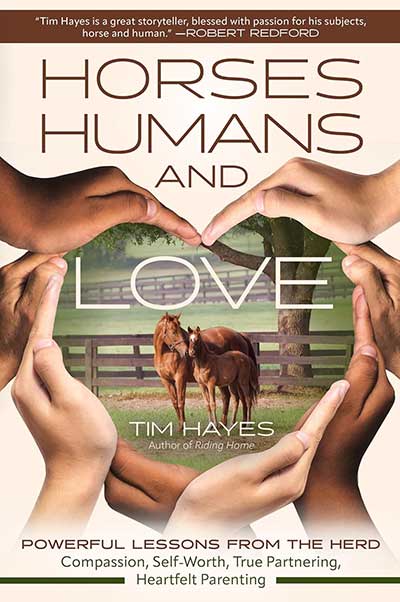
This excerpt is adapted from Newcomer to the Horse World by Andrea Sinner, Esq.,
As I spent more time in Idaho on the lands the Blacks ranched, I began to feel a desire to leave New York City, where I had lived my whole life. Feeling equal parts excitement and anxiety, I decided to move to an old farming area at the end of New York’s Long Island.
Within the first few days after I moved, I drove around, looking for any sign of horses. I called Okie and asked him what he thought I might do to keep horses in my life.
“Tim,” he said. “Do they have any Western barns out there? You could offer to exercise their horses.”
I told him it seemed like, from what I could see, most of the barns were for English riders—sports like dressage, jumping, and polo. But there was a place called Deep Hollow Ranch located in a little town called Montauk, named after the Montaukett Tribe of American Indians.
“They told me they give trail rides,” I said to Okie.
“Good,” he replied. “Go out there and be a trail guide.”
The very next day, I drove to Deep Hollow Ranch to ask for a job that wasn’t in the film and television industry. After parking in a dirt lot, I walked into a tiny office attached to a large barn. Sitting behind an old wooden desk was a tall attractive woman with long black hair and turquoise earrings. She looked up at me.
“Hi, I’m Diane,” she said. “Can I help you?”
I began to experience what would probably now be called imposter syndrome (doubt of my actual skill with horses) and a sudden rush of anxiety. Although it began to dissipate when I noticed that, just like me, Diane was wearing Wranglers, it wasn’t enough to stave off nonstop thoughts of quiet desperation: This is my only chance…. Horses may not be in my future…. What can I say to make her say yes?
“My name is Tim Hayes,” I began, “and I’ve studied with Pat Wyse out in Idaho.”
Diane looked me up and down and said in a flat voice, “I don’t know who that is. How can I help you?”
I had nothing else. I tried to look honest and humble as I replied, “Do you need anyone to help exercise your horses?”
I turned to walk out, trying to leave before Diane could answer my question with a “No.” My thoughts darkened with sadness and failure.
“No,” I heard her say behind me as I reached the door. “But…we need trail guides. Rides go out every day for an hour and a half. Are you interested?”
As I turned back to face her, I mentally reviewed the following facts:
I don’t know enough about horses.
I’m not good enough or confident enough to lead people on trail rides.
There’s no way I can or should be responsible for the safety of other riders and their horses.
If someone has a problem with a horse, I will have no idea how to help them.
This is too risky—probably dangerous.
I’m not qualified, and it’s way over my head.
Then I looked into Diane’s eyes, tried to squint like Clint Eastwood, and said, “Sure.”
Including some public land owned by New York State, Deep Hollow Ranch had close to four thousand acres to explore. Trail rides consisted of going deep into wooded areas on narrow dirt paths until you emerged on a magnificent sandy white beach, overlooking the Atlantic Ocean and across to the coastline of Rhode Island and Connecticut. The ranch kept about a hundred Quarter Horses, was open all year, and employed about fifteen trail guides during the busy summer season. Most were college-age men and women, and they came from everywhere in the country—a few even came from Ireland. And although I was old enough to be their father, I needed to constantly ask them for horse help.
Customers were put on the older, mellow horses. Since the guides were supposed to be “experienced equine professionals,” we rode the horses that still had “issues” that needed to be resolved (in other words, the ones that liked to rear or bolt).
Whenever I rode a horse that resisted my requests, I was always told by the others on staff: “Tim, get after him,” and “Show him who’s boss.” These were euphemisms for kicking hard with spurs or pulling forcefully on the reins. It frightened me, it felt wrong, and I hated doing it.
But I didn’t know what else to do.
I must have taken out hundreds of rides in the ten years I worked as a weekend volunteer trail guide in Montauk. I was kicked, bitten, reared with, bucked off, stepped on, and dragged. However, when I think back to all the saddling, grooming, and interacting on the ground I did with so many different horses, I realize how invaluable every experience was in my horseman’s education. Being good or “getting handy” with horses usually has very little to do with horseback riding. It never occurred to me then that unless I learned to establish a positive mental and emotional connection with horses on the ground, I would be left, like most people, with no alternative but to try and control them with physical force when I got on their back to “show them who’s boss.” And just as with a human adult or child, it would eventually become ineffectual in creating a harmonious or safe relationship.
Being a trail guide not only taught me more about horses, it taught me about myself. It further revealed the importance I gave to what other people thought of me. For example, when it came to getting hurt, I discovered that even factoring in all my different horse-related “accidents,” the most painful experiences were those involving my ego. I can easily recall two memorable episodes involving my attempt to save face as a “professional” trail guide.
The first was getting lost on my very first ride. Although the four thousand wooded acres of Deep Hollow Ranch were surrounded by Long Island suburban civilization, which included an occasional house, no one was more surprised than I was when I realized I had accidentally led my group of eight riders up the driveway of someone’s two-story colonial home. (I was later informed that it was a “first” in the history of Deep Hollow Ranch trail guides.) Before any of the riders following me had the chance to exclaim, “Hey, Tim, is this the right way?” I looked back at the group and in my most commanding John Wayne voice yelled, “Follow me! This is where we always make a U-turn and head out toward the beach.”
For the rest of the ride all I thought about was what I would say to Diane when one of the customers mentioned the “pretty house we rode by on the trail.”
No one ever did.
 Horses, Humans, and Love: Powerful Lessons from the Herd―Compassion, Self-Worth, True Partnering, Heartfelt Parenting
BUY NOW on Amazon
Paperback | Kindle
This excerpt is adapted from Horses, Humans and Love by Tim Hayes and is reprinted here with permission from Trafalgar Square Books.
You can find more interesting reading in our sections for Books and Trail Riding. While you're here, check out our Curated Amazon Store for everything you need for a happy horse and rider.
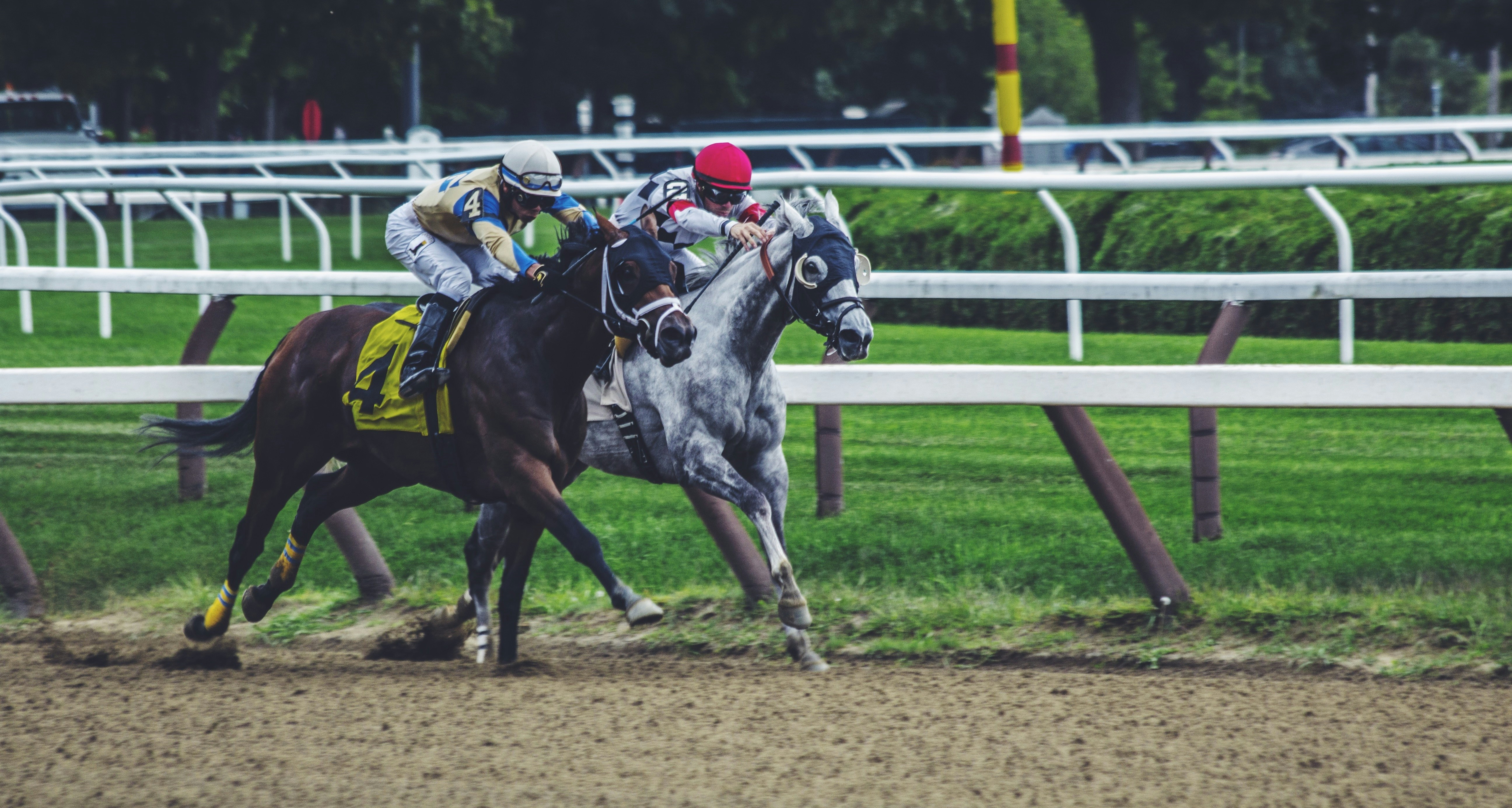
Betting is a huge part of the horse racing experience. But modern technology has taken this aspect of horse racing to new heights.
According to Business Research Insights, the global horse racing market was worth $21.75 billion in 2024 and is projected to reach $40.7 billion by 2033 by 2033. With betting being so closely tied to the sport, it's no surprise that some horses are in such a way that ties the two subjects together. Gaming-related names are very common, representing an affinity with another betting pursuit. So, with that in mind, here are some racehorses that have gone all-in:
Poker
When Poker defeated champions Assagai and Buckpasser in the 1967 Bowling Green Handicap, he effectively changed the horse racing scene. He became the inspiration for Poker Stakes, a Grade III American Thoroughbred horse race held annually in Belmont Park, the same location where he achieved that upset in 1967. The Poker Stakes race is also where champion Thoroughbred Oscar Performance set a speed record in 2018. Poker was also a Champion Broodmare Sire, with his daughters producing numerous champions, including champion sire Seattle Slew.
Moni Maker
Moni Maker was one of the most successful horses in history, with 67 wins, 18 seconds, and 10 thirds in 105 races. Aside from competing in America, she raced internationally, winning major races like the Copenhagen Cup and Prix Prix d'Amérique. True to her name, she became the richest Standardbred when she retired in 2000, and won awards like the United States Horse of the Year.
Moni Maker also shares a similar name to another money-making icon. Around the time she was racing, the accountant turned Americas Cardroom Pro Chris Moneymaker was honing his poker skills. He made history when he won the World Series of Poker in 2003 after qualifying through an online poker site, igniting the poker boom often dubbed the "Moneymaker Effect." The poker legend currently represents the Amercias Cardroom site at major tournaments and tours, including his own. Both Moni Maker and Chris Moneymaker are Hall of Famers in their respective fields.
Laddies Poker Two
Laddies Poker Two didn't have a very long career, but she won her fair share of races in 2008 and 2010. At the Median Auction Maiden Stakes, she beat the favorite Ocean Legend, garnering attention. While she didn’t participate in races in 2009, she made a reappearance at Wokingham in 2010; winning on a seasonal reappearance in a highly competitive, big-field sprint handicap made the achievement even more monumental. Her name also comes from her owners, betting company Ladbrokes. She retired after her win at Wokingham, but the impressive feat pulled off by her and trainer Jeremy Noseda made her a racehorse to remember.
Poker Face
Poker Face had an impressive start to his racing career, winning all of his races in 2022. The gelding also saw remarkable wins in 2023, placing first at the Pomfret Stakes, Prix Quincey, and the Prix Daniel Wildenstein one after the other. He continued with a modest career and a few more wins until his passing while training in 2025. Poker Face was named after the expression a poker player would wear to avoid giving away their hand. It was a fitting name for an unpredictable yet skilled racehorse who gave his all.
Poker Chip Peake
Though not technically a racehorse, Poker Chip Peake made a name for himself in the calf roping world. He was known for his perfect conformation and great "cow sense," making him an icon in the field. His skills helped him become one of the timed-event horses inducted with the ProRodeo Hall of Fame's inaugural Class of 1979, a rare accolade only achieved by four other horses in the 40 years since. He's named after the iconic currency one would see at the poker table, and like his namesake, he was a valuable horse. A tragic accident unfortunately ended his career, but his legacy has lived on to this day.
You can find more interesting stories in our section on Racing & Wagering.
by Kristin Pitzer
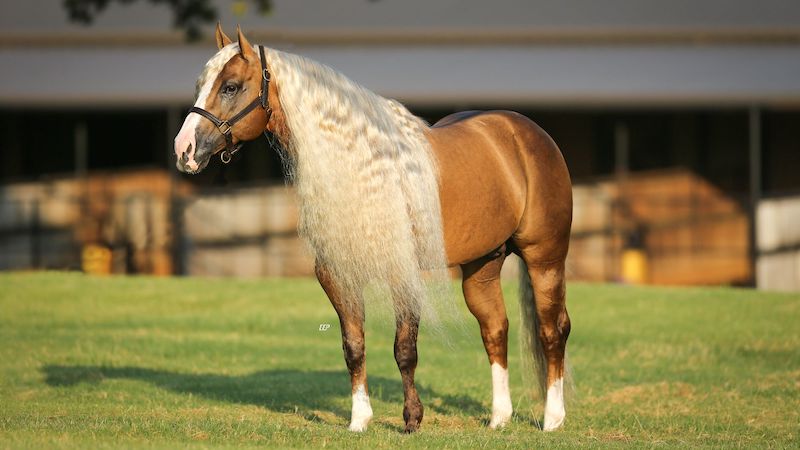
With all the work that goes into getting a horse prepared mentally and training-wise for an event, you might be tempted to neglect your grooming routine before or during a show. After all, judges won’t typically deduct points if a horse has a tangled tail or small urine stains, as long as he’s performing the correct maneuvers skillfully.
Still, there’s something about a freshly groomed horse that improves its presence in the show pen and helps make a lasting first impression. Even better, the time you put into caring for your horse’s appearance can pay off by helping you look and feel like a winner, even if you don’t place.
Quarter Horse News asked Katie Davis, assistant trainer at Trent Harvey Performance Horses, for some tips on how to groom horses so they’re show-ready.
Bathe Before Shows
The day before you leave to take your horse to a show, Davis recommended giving him or her a bath with a high-quality shampoo and conditioner. That way, you’re putting your best foot forward from the moment you arrive, rather than unloading a horse that looks dirty and neglected.
“It’s good presentation for your farm — you don’t want to be rolling out of the trailer with a bunch of poop stains on your horse,” Davis said. “Obviously, anything can happen in the trailer depending on how long your haul was, but you want to take pride in your farm and pride in your horses.”
Be sure to use products formulated for horses, as other soaps could strip the hair of natural oils and leave the coat dull and drab. During the event, you can make your horse’s bath last longer by thoroughly rinsing the sweat and loose hair off them after every ride.
Keep Manes Manageable
Davis rides reining horses, which tend to have long, flowing manes, but her advice on mane care can apply to any show horse. For starters, when bathing the horse, focus on getting the mane free of any dirt and debris. Then, once it’s clean, use a mane brush and detangling spray to carefully comb out any snags.
“Always start from the bottom and work your way up when you’re brushing out a long mane, just like you would with long human hair,” Davis said. “Detangle one knot at a time, rather than all of them at once.”
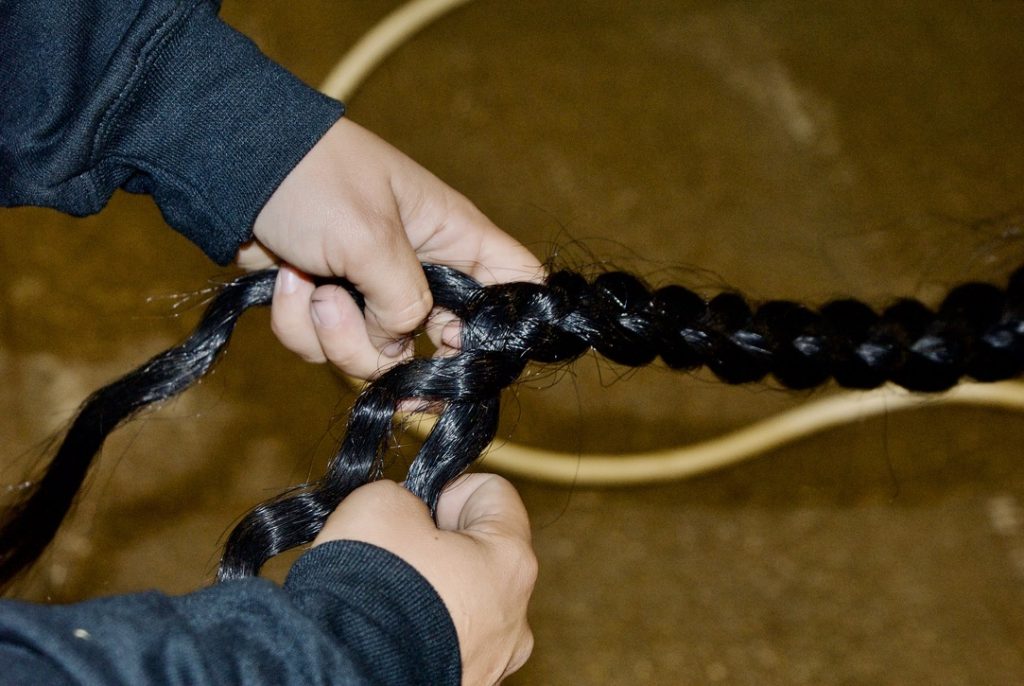
When you’re not showing, you can secure the mane in small braids to protect the hair. Davis likes to give each horse a set of fresh braids the night before hauling, securing them with braider bands made for horse manes.
“The smaller the braid, the longer it will last,” Davis said. “If you make really wide sections, their skin is going to stretch as they reach their neck down and shorten as they reach up, pulling on the hair. If you take smaller sections, you’re not going to have that issue.”
Protect Tails
Tails should be treated like manes when brushing them out — for instance, never insert a brush into the hair at the top of an unbrushed tail and yank straight down. This is a sure way to break your horse’s tail hair, resulting in shorter, thinner tails. Instead, start at the bottom of the tail, and detangle any knots you find gently.
After the tail is clean and brushed, you can decide whether to leave it loose or braid it and put it in a tail bag. Because reining horses run, stop and back up hard, their tails are often put up while they’re being ridden to avoid stepping on them and ripping any hairs out. Otherwise, unless Davis has a horse that constantly pees on its tail, she won’t leave tails braided.
“The ones we leave unbraided, we just keep them brushed and braid them daily before riding,” Davis said. “There’s just a less likely chance they’ll pull a out a chunk of hair if the tail is loose because if it gets caught on something, it just combs through like a brush, rather than getting stuck on a braid and pulling out a chunk from the top.”
Don’t Forget Faces
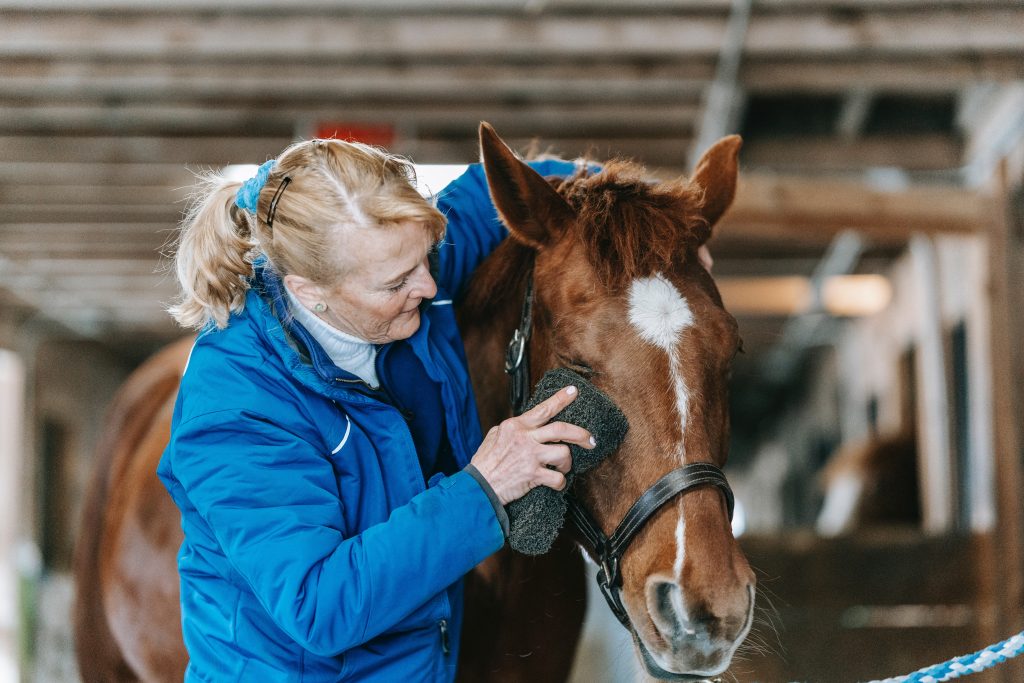
One thing Davis sometimes sees at shows is horses that are clean from the neck down but have dusty faces, usually because they don’t enjoy having their faces washed. If you’re going for the “wow” factor, though, a shiny, clean face can really add to your horse’s appearance.
“You want to make sure that up under their forelock and the backside of their ears doesn’t get a buildup of sweat and dirt,” Davis said. “I usually just use water, unless I see buildup, and then I’ll use a betadine soap and let it sit about five to 10 minutes before I rinse it off. That way, I don’t have to scrub really hard and irritate the horse more than I’m already doing.”
In addition to cleaning dirt and debris off the horse’s face, the betadine scrub will also kill any yeasty bacteria or funguses that might be living on the skin, she added.
Bring Your Tools to the Warm-Up Pen
Getting your horse clean and prepared for a show doesn’t end with a single bath and hair brushing. You’ll need to maintain that level of cleanliness throughout the event, especially right before your horse enters the show pen.
Before you head to the ring, prepare a small grooming bag with a couple brushes, some towels and grooming sprays. That way, after you warm up, you can freshen your horse up for his turn in the spotlight, even if he got a little sweaty beforehand.
“I go through a lot of towels wiping off faces, wiping out mouths and nostrils, and cleaning off sand — making sure it doesn’t look like they’ve just been sweating when they go in,” Davis said. “I’ll brush out the tails, give them a good coat of fly spray and a little bit of a shine spray, and then brush them down to help the shine spray settle into their coat.” It might seem like a lot of effort to get your horse in show-ready shape, but a horse that looks good can be a big confidence booster while showing everyone else you’re a serious contender from the get-go.
This article originally appeared on American Quarter Horse News and is published here with permission.
There are more informative and entertaining articles in our section on Health & Education. While you're here be sure to check out our Curated Amazon Store.
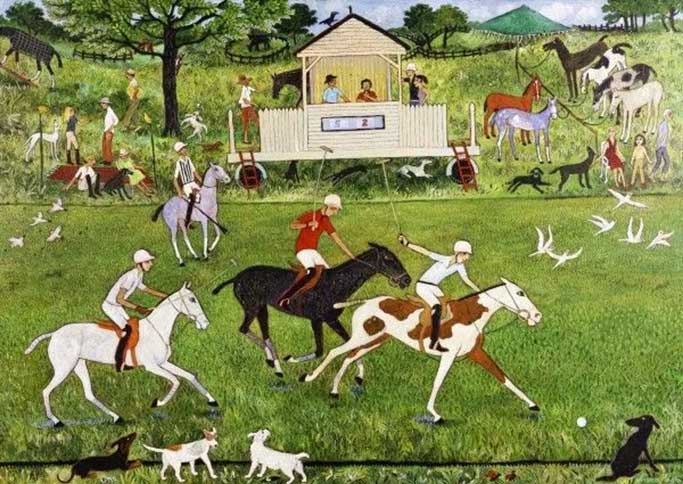
The idyllic scene above showing the freshness and vitality of a country polo match is by Anna Pugh, one of England's leading artists, colourists and visual storytellers, Anna’s original painting, ‘Whose Ball Anyway?’ until recently was stabled in a racing yard in Suffolk, England, alongside thoroughbred equine athletes. So how come its new home is in the city of Orange in the central Tablelands of NSW?
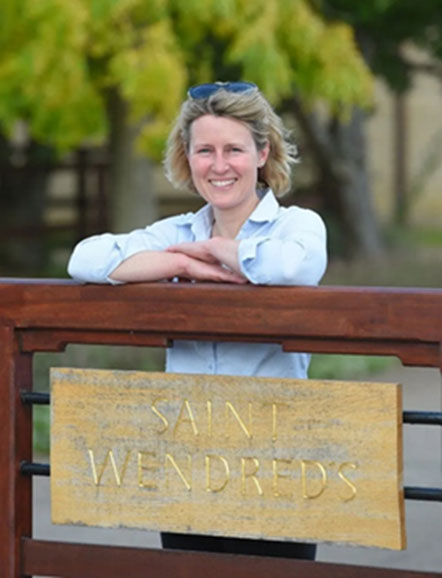
Meet Ilka Gansera-Leveque, racehorse trainer, equine vet and most recently, curator of the premier Art and Horseracing Gallery’s collection of ‘art that makes you feel good’.
Ilka is the only UK-based female racehorse trainer who is also a qualified vet. Throughout her life her passion has been horses and for the last seven years she has worked in partnership with her husband, Stéphane, ably assisted by their teenaged daughter Eléa, building their training business, in Newmarket, where modern, organised horseracing was instigated by King Charles II in 1666.
Over to Ilka: “What we do is a vocation and we live and breathe horseracing. Our home is above our yard, Saint Wendred’s and we work a 16-hour day, seven days a week.
“There’s no ‘one size fits all’ approach here. I’m dedicated to the wellbeing of the horses, ensuring each is cared for and trained as an individual. Understanding our horses’ personalities and supporting their development in every way possible are key to getting the best performance. It’s always the horse that dictates the next step and every step thereafter.”
Born in Germany, Ilka and her family moved home every three years as her dad, a German Airforce fighter pilot, was stationed at various bases in Germany and America. Ilka inherited her mum’s love of horses and started riding as soon as possible. Her dream of owning a horse came true at 13, when she was given an Arabian called Badur.
As ilka recalls fondly, “I devoted every free second to looking after Badur and riding.
I grew up knowing I wanted to be a jockey and I left school early, when at 16 I was offered a three-year jockey apprenticeship at champion racehorse trainer, Bruno Schütz’s stables, in Cologne. Then, it was unusual for girls to work in racing and while my school disapproved, my parents let me follow my dreams.
In the early nineties, I spotted the ‘Horse Whisperer’ Monty Roberts, then touring Germany, at a racecourse. I introduced myself and said I’d like to work for him. Realising I’m bilingual, Monty’s interest was piqued and we made a deal: if I could teach him to speak German, he’d teach me everything he knew about horses. We shook on it!
It was such a great opportunity and Monty took me on as an apprentice in California. During five years in America, my ambition evolved from being a jockey to training and veterinary medicine and an unbelievable tragedy steered my path. I was on Long Island in 9/11/01 when the Twin Towers were destroyed and it shook me into the firm decision to become an equine vet.
In 2003, I started a degree in Veterinary Medicine at the University of Hanover and while on a placement at Dubai’s Equine Hospital, I met French rider, Stéphane Lévêque. Stéphane was working with Sheikh Mohammed’s global racing team, Godolphin, spending six months in Dubai and six months in Newmarket. We became close in Dubai and continued a long-distance relationship while I studied in Germany.
I qualified as a vet in 2009, moved to Newmarket and Stéphane and I married. In July 2010, our daughter Eléa was born. Before Eléa was one, I started a 12-month veterinary internship at the world-renowned Rossdales Equine Hospital in Newmarket. Stéphane continued to ride out for Godolphin and looked after Elea while I was at work.
In 2011, Stéphane had a riding accident and nearly died. The experience made us reflect and realise we had to do what we really wanted and that was to train our own horses. Stéphane had completed the British Trainer’s course in 2009 and when I qualified in 2012, we started to build a business from scratch.
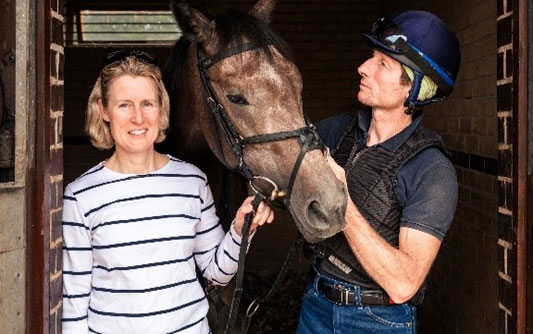
Beginning with one horse in a rented stable, we progressed to buying Saint Wendred’s racing yard in 2015, with 32 boxes and the bonus of living quarters above the stables.
Fast forward to now and IGL Racing is a thriving family business, with 15 horses in training, ridden out daily by Stephan, Ilka and daughter Eléa who has the enviable treat of galloping the finest thoroughbreds before her school day starts. As well as the horses, Ilka manages two racing syndicates, a monthly podcast and now, a collection of beautiful fine art.
Based in the tranquil setting of St. Wendred’s, Ilka’s Art and Horseracing Gallery showcases art inspired by nature and hard work, housed in converted stables alongside her thoroughbred athletes. Launched in spring 2023, initially to offer a unique experience for racehorse owners visiting the yard, the collection has already grown to over 500 pieces of original art and sculpture by national and international artists. The gallery’s progress has been impressive and as Ilka explains, “Integrating art within our working yard brings to life all that's beautiful about the horses we’re lucky enough to nurture and live with and the nature that surrounds us. Our artists love the concept of their work being shown in a stable and visitors to the yard are surprised and delighted by what’s revealed when we open St. Wendred’s special stable doors. Our eclectic range includes horses, dogs, wild fauna, land and seascapes, racing, cycling, rowing, & rugby.”
Stable stars include New York painter Diana Cook, renowned for her quintessentially English scenes, English folk artist Anna Pugh, who is in her mid-80s with failing eyesight, making her pieces exceedingly rare, textile designer Elizabeth Castell who features in the V&A and Ukrainian street photographer Jean Kosse, whose black and white images capture the extraordinary in ordinary moments.
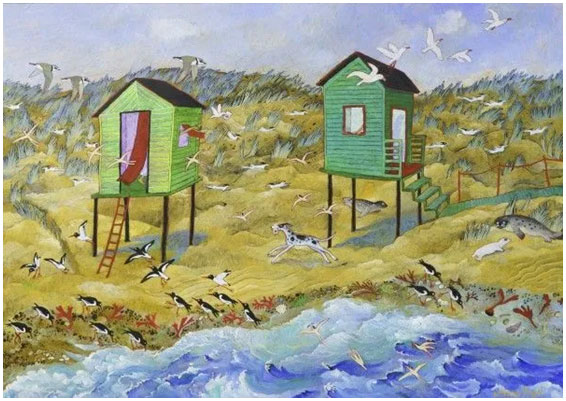
So that’s how Anna Pugh’s ‘Whose Ball Anyway’ and ‘Love You Too’, along with Marco Ramassa's painting (pictured below) came to be in the Tablelands of NSW.
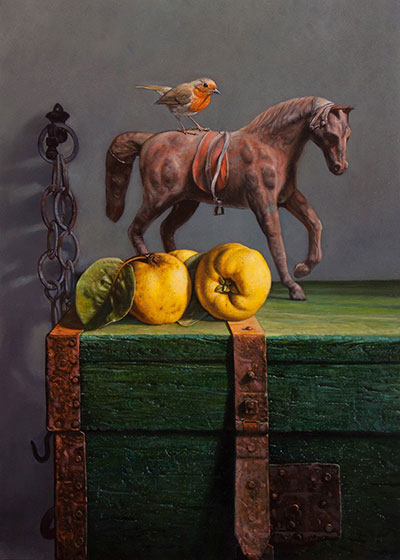
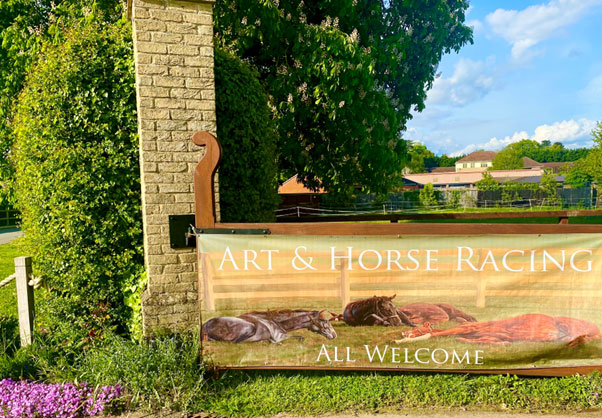
The gallery is open to visitors seven days a week from 10 until 6 and of course, all the art is available to view and buy online. Visit www.artandhorseracing.com to see the full range of art available.
For full information about Ilka’s unique approach to training, becoming the owner of an equine athlete, syndicates and much more visit: www.gansera-leveque.com.
Finally, check out Ilka’s podcast: Vantage Point Racing Club Podcast
There are more interesting articles in our sections on Recreation & Lifestyle, Artwork and Clinicians & Trainers. While you're here, be sure to check out our Curated Amazon Store.
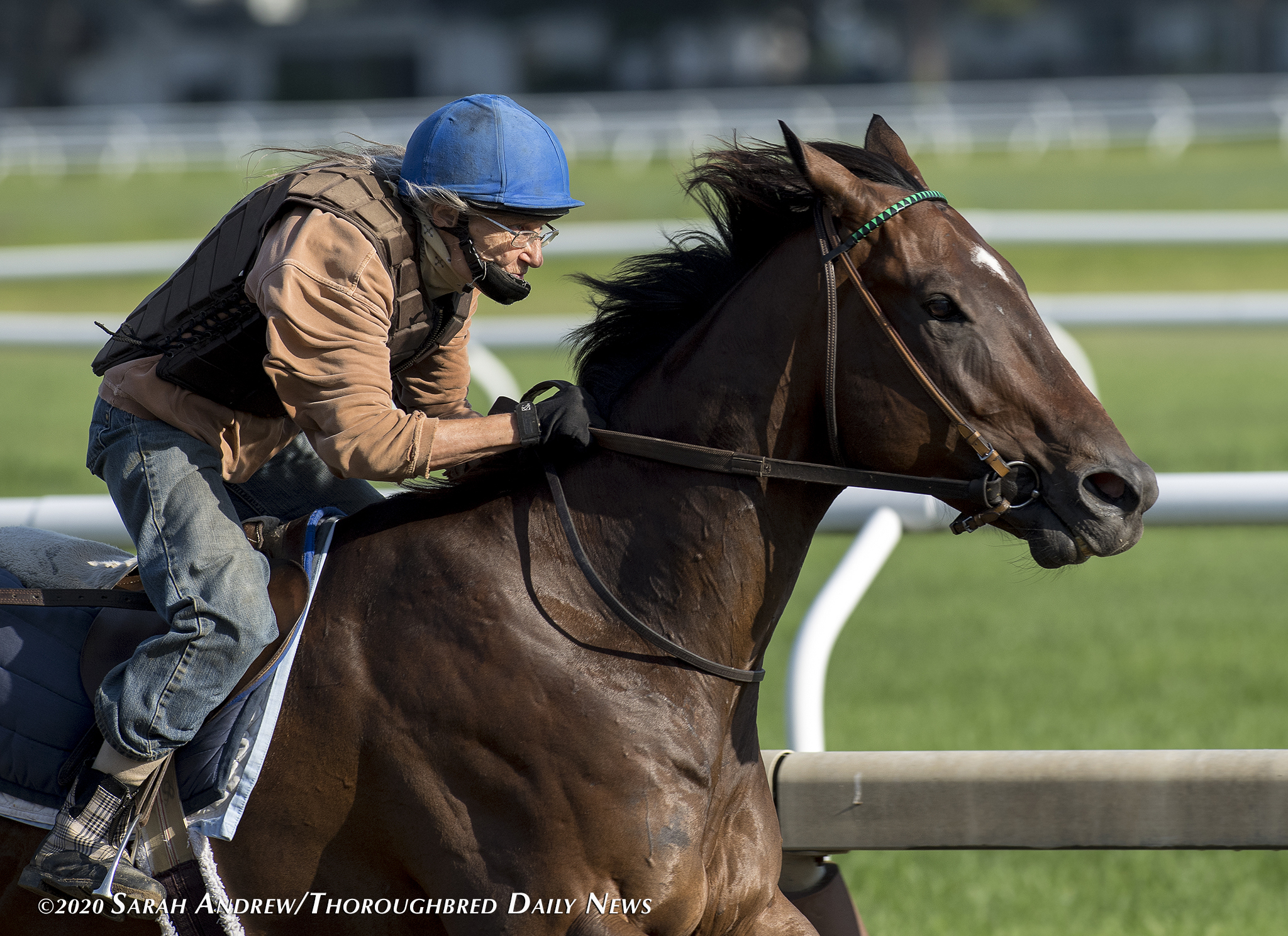
EIE Publisher's Note: Many mornings at the Oklahoma training track at Saratoga, we watched in awe as Patricia Meadow, known fondly as the "Galloping Granny" train her horses, riding them herself. She was a legend at the racetrack and was often three times older than many of the riders sharing the track with her. It wasn't until after her passing, from an article published by the Thoroughbred Daily News, that we knew about her interesting past which included degrees from Harvard University. Like her, we hope at her age we'd be able to enjoy life astride a galloping horse.
Please take a moment to read For Patricia Meadow, A Life with Horses Was Both Destination and Journey, courtesy of the TDN.
You can find more informative articles in our section on Recreation & Lifestyle.
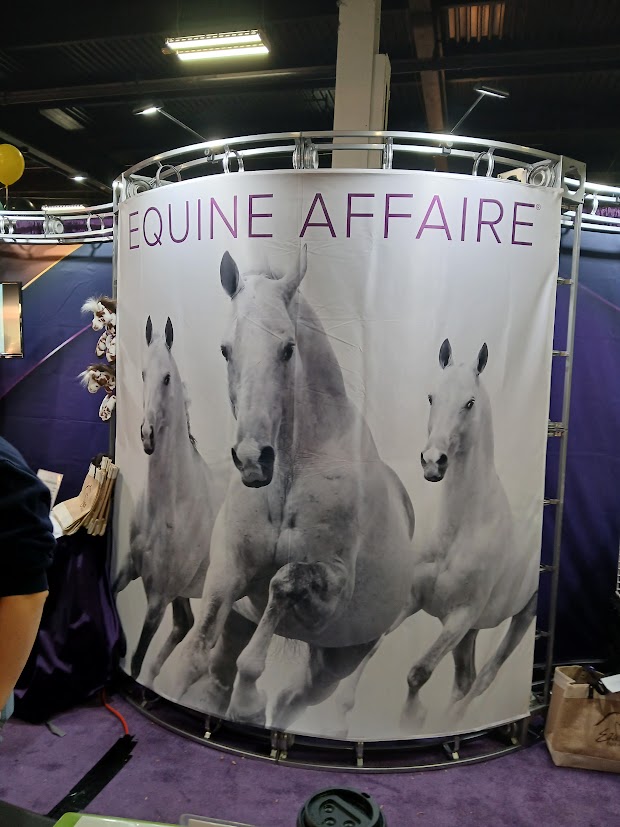
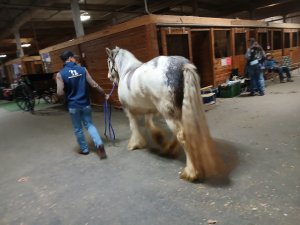
EquineInfoExchange had a great time at the Equine Affaire in West Springfield, MA, and everyone enjoyed the beautiful weather. We attended demonstrations, competitions, and learned about amazing new products. We visited the barns and had a chance to pet beautiful horse breeds including Minis, Clydesdales, Fjords, Arabians, Thoroughbreds, Mustangs, Icelandics, Gypsies and many more! It also gave us the opportunity to reconnect with old friends and meet new ones who share our love and passion for horses.
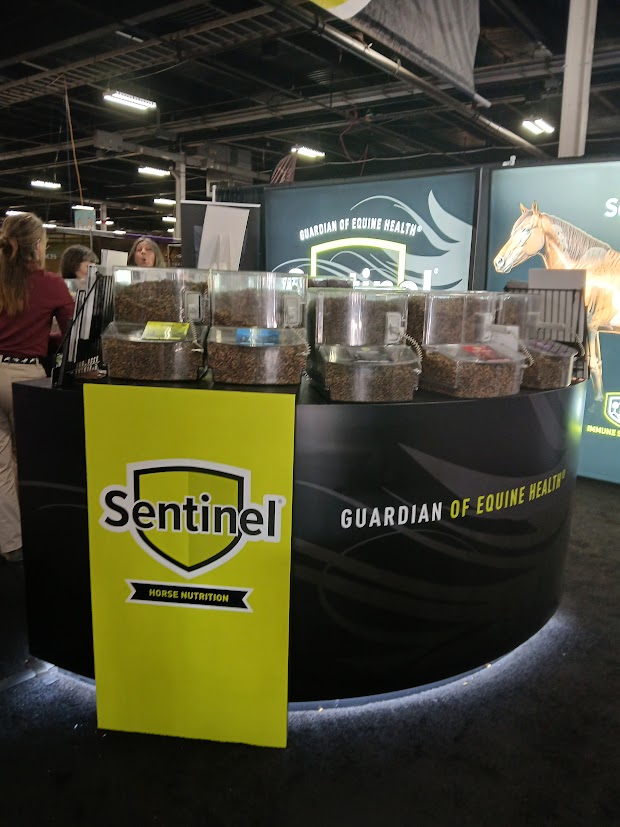
Some of the booths we visited included Sentinel Horse Nutrition, Purina, Semican, Tribute, Poulin Grain and Aden Brook who are all included in our Bedding & Feed page.
We also stopped by Bemer Group and learned about EquineSleeve and added both to our Therapy page.
SmartPak gave away product samples and was a very popular booth.
It was the first time the National Museum and Racing Hall of Fame attended! They are included on our Museums page. If you are in Saratoga Springs, NY, make sure to visit them!
Dubarry of Ireland, State Line Tack, and LM Boots are all included in Tack & Apparel.
Trafalgar Square Books, who publishes content on EIE, had authors promoting and signing their books. See them in our Books section and read excerpts.
We were thrilled to see rehoming organizations such as the Thoroughbred Aftercare Alliance, the Mustang Valley Sanctuary and the Thoroughbred Retirement Foundation. EIE has the largest directory of Rehoming organizations in the world so if you are seeking a horse, please consider adoption or make a donation!
Mainline Fence & Supply Corp. is another recurring vendor who is included on our Fencing page.
R. Blackington, the official creators of the Kentucky Derby trophy, Impressions of Saratoga, The Bent Nail and Sona Equestrian join our Jewelry & Gifts section.
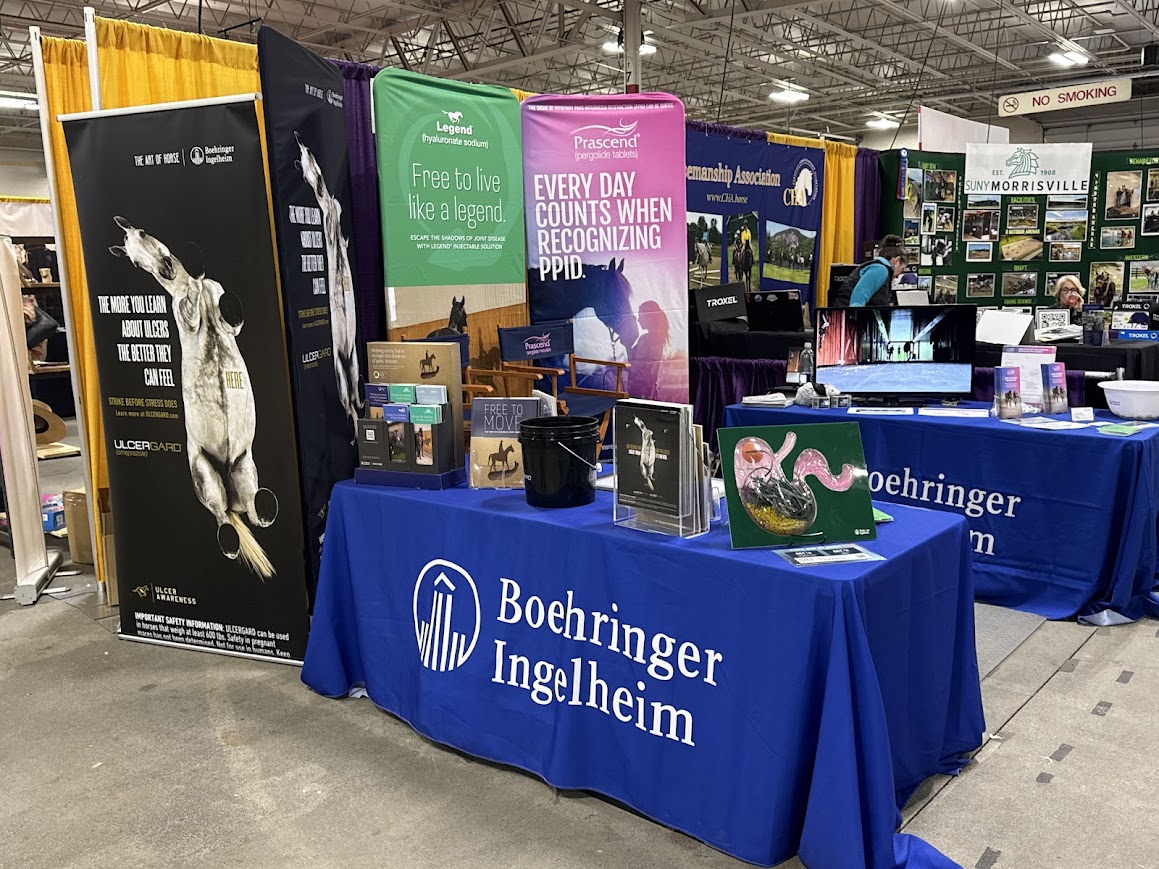
Boehringer Ingelheim Equine, whose products include GastroGard, Luitpold Animal Health, makers of Adequan, and Life Data Labs are included in Supplements.
Chewy who had a cool spinning wheel for prizes was added too. They had a long line of people waiting to spin the wheel!
We are continuing to add businesses every day and will share them on social media. We have a social media reach of over 3,000,000 a month!
Do you want your business added to EIE? Email us at info@equineinfoexchange.com with your company's website and we will include you too!
Be sure to look over our Photo Gallery below.
You can find more interesting articles in our section about Recreation & Lifestyle.
Equine Affaire 2024 Photo Gallery
Click any image to view larger and start a slideshow presentation.















- Horse Lover Lady Gaga Gets Mixed Reviews. Are People Walking out of Joker: Folie à Deux?
- Discover Kentucky’s Best Horseback Riding Trails
- The Winners Circle Introduces $HRSE Token, Promotes Digital Currencies for Horse Racing
- Dealing with Rising Horse Ownership Costs
- Can We Help Address the Shortage of Veterinarians?
- Want to Be a Supportive Parent at Horseback Riding Lessons? Here's How!
- Five Fantastic Horse-themed Games to Play Today
- Buying Horse Property? Here's What You Need to Know
- Horse Properties For Sale in Colorado
- Horse Properties For Sale in Connecticut