




by Kentucky Equine Research Staff
Horses are "trickle-feeders” that naturally graze between 12 and 20 hours each day. However, modern management practices often require horses to be stalled for long periods of time, which may limit consumption and contradict natural grazing behavior.
Understanding how horses adapt their eating behavior under such management is essential for optimizing digestive health, welfare, and performance. Furthermore, the timing of forage consumption is especially relevant for performance horses that are often exercised early in the morning. Overnight feeding behavior therefore plays a particularly important role in gastric health. When horses consume forage, saliva is produced containing bicarbonate, which buffers gastric acid. A fiber mat is also formed in the stomach that floats on top of the gastric acid. This mat acts as a physical barrier, which may protect the nonglandular region of the stomach from acid exposure.
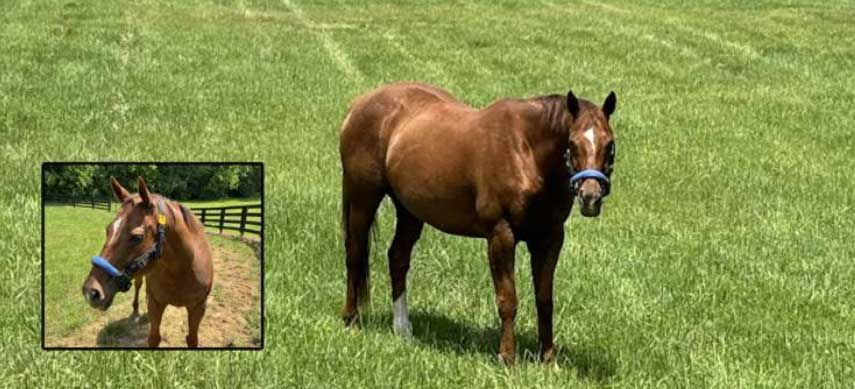
Kentucky Equine Research has recently used innovative technologies to investigate equine ingestive behavior. Chewing halters developed by Itin + Hoch allow researchers to quantify chewing time, frequency, and intensity to investigate the consumption behavior of horses. The chewing halters have previously been validated as a tool for tracking feeding behavior.
A recent study explored how horses chew overnight when offered free-choice timothy hay in one versus two hay nets within a stall using the chewing halters to continuously record chewing activity overnight. The study objective was to determine whether providing two forage access points would encourage more movement around the stall, spread chewing more evenly throughout the night, and increase total chewing time. The objective of the study was to encourage a more natural grazing behavior while stalled, and resulting patterns could tell us about equine behavior.
One of the main takeaways from this study was the strong influence of time-of-night on chewing behavior. Regardless of the number of hay nets provided, horses followed a consistent overnight rhythm of intake. Chewing activity was highest between 6:00 p.m. and 10:00 p.m., and gradually declined throughout the night, with a distinct resting phase from 9:00 p.m. until 5:00 a.m. when consumption was lowest. Intake increased before dawn again before their morning feed was given.
This time-driven pattern suggests that horses regulate their feeding behavior following circadian rhythms rather than responding solely to changes in feeding setup. Even in a stalled environment, horses maintained eating and resting cycles that closely resemble natural grazing behavior, reinforcing the role of circadian rhythms in shaping ingestive behavior. These findings highlight that overnight feeding is not simply about providing forage access, but about understanding when horses are most motivated to eat and how that motivation changes across the night.
By aligning feeding management with horses’ natural chewing rhythms, especially in the hours preceding morning work, caretakers may better support digestive comfort, reduce ulcer risk, and promote optimal performance. If a horse consumes most of its forage early in the evening and experiences a prolonged period of reduced intake overnight, the stomach may be relatively empty by the time morning exercise begins. During exercise, gastric contents shift, and in the absence of a sufficient forage mat, the occurrence of gastric acid splashing onto the sensitive nonglandular mucosa increases, heightening the risk of gastric ulcer development.
The time-dependent chewing patterns observed in this study suggest that even when forage is available overnight, horses do not consume it evenly across the stabling period. Recognizing these natural declines in intake can help inform feeding strategies aimed at maintaining forage presence in the stomach closer to exercise time. Management practices that support sustained overnight chewing, such as hay nets with smaller holes, rather than rapid early consumption alone, may therefore offer protective benefits for gastric health.
Variation in individual intake was also seen in the current study, which could be explained through horses’ social biology. Horses are herd animals that rely on rotational vigilance, where some horses rest while others remain alert to maintain safety. If horses maintain aspects of this herd-based behavior when stalled, individual differences in chewing and resting overnight may reflect personality traits, social dynamics, and nocturnal vigilance.
Although this study did not show a universal advantage of two hay nets over one, it reinforces the idea that feeding strategies should aim to support prolonged, consistent chewing while respecting individual preferences. For some horses, multiple feeding points may encourage movement or reduce boredom; for others, a single, familiar location may be preferable.
The results of this study emphasize that overnight chewing behavior is shaped more by time, biological rhythms, and individual traits rather than by the number of hay nets alone. Horses follow natural patterns of eating and resting, even in confined environments, and these patterns vary between individuals. Rather than searching for a one-size-fits-all feeding solution, horse owners and managers may achieve better outcomes by observing individual behavior and adjusting feeding strategies accordingly. Small management changes, such as feeding location, forage presentation, or timing, may have subtle but important effects that only become apparent when horses are evaluated individually.
Crandell, K. “Why Is Feeding Frequency Important in Horse Management?" Kentucky Equine Research. Accessed January 25, 2026.
This article was written by Savannah Jackson, a yearlong intern at Kentucky Equine Research. As part of the intern program, participants are asked to contribute to Equinews. Learn more about the internship program.
Reprinted courtesy of Kentucky Equine Research. Kentucky Equine Research is an international equine nutrition, research, and consultation company serving horse owners and the feed industry. Our goals are to advance the industry's knowledge of equine nutrition and exercise physiology, apply that knowledge to produce healthier, more athletic horses, and support the nutritional care of all horses throughout their lives. Learn more at Kentucky Equine Research.
There a more informative articles in our section on Health & Education. While you're here be sure to visit our Curated Amazon Store.
Are you interested in promoting your business or sharing content on EIE? Contact us at info@equineinfoexchange.com