





Health & Education
We all want the best care possible for our horses. The Heath & Education section covers both Learning Institutions, Organizations as well as many sources for equine assistance including Veterinarians and Farriers.
For those who want a to formally study horses, the Education section includes College Riding, Equine Studies, and Veterinary Schools. Learn about the wide variety of horses in the Horse Breeds section. Supplements and Treatments Therapy are also included in the section.
Everyone can learn from Fine Art and there are some specialty Museums that might surprise you.
Horses as a therapy partner enrich the lives of the disabled. These facilities are listed in our Therapeutic Riding section. To help children and young adults build confidence and grow emotionally, please see the resources available on the Youth Outreach page.
Looking for a place to keep your horse? You can find it in the Horse Boarding section. Traveling? Find a Shipping company or Horse Sitting service if your horse is staying home!
Want to stay up to date with the latest training clinics or professional conferences? Take a look at our Calendar of Events for Health & Education for the dates and locations of upcoming events.
Do we need to add more? Please use the useful feedback link and let us know!
Roaring in horses is not just a loud, raspy noise made during exercise; it is an issue in the upper airway that restricts airflow and can limit performance in large breed horses such as Thoroughbreds, Standardbreds, and warmbloods. Ontario Veterinary College associate professor of Large Animal Surgery, Taralyn McCarrel, is seeking to develop a surgical procedure that could revolutionize the treatment of tie-back surgery, offering new hope for affected horses.
Roaring, or recurrent laryngeal neuropathy, is a condition where one of the nerves controlling the muscles of the throat becomes dysfunctional. This commonly results in paralysis of the left arytenoid cartilage.
McCarrel provides a quick anatomy lesson, comparing the trachea to a castle, “The airway is made-up of two cartilages called the arytenoids. The arytenoids close like doors to cover the trachea, and then the epiglottis is like the drawbridge that comes up and covers them.” With recurrent laryngeal neuropathy, the control to open the doors is abnormal and overwhelmingly, it is most common that the left side becomes affected.
When the nerve fails, the muscle atrophies and the horse struggles to open the left door of the airway because it lacks the stimulus to contract. Due to the inability for the left arytenoid to be held open, the tissue is left flapping and causes the ‘roaring’ noise. The laryngeal neuropathy puts a limitation on the volume of air available for oxygen exchange which can significantly impact the horse’s exercise tolerance, causing them to tire quickly.
McCarrel points out, “This condition is long recognized, with scientific reports dating back to before the formal establishment of veterinary medicine.” Affected horses often exhibit signs of nerve abnormalities throughout their bodies, though these do not have observable consequences aside from the paralysis of important laryngeal muscles. The most noticeable sign is the loud noise produced during exercise if there is a limitation in airflow.
Roaring is most common in large breed horses, with draught horses estimated around 33% prevalence. Thoroughbreds have a lower prevalence, ranging from 2% to 8%, while warmbloods are also affected. The condition is often detected early in racehorses due to routine scoping, but in warmbloods, it may go unnoticed until they are older and working harder. Interestingly, some high-level dressage horses can have a completely paralyzed arytenoid cartilage yet make minimal noise, possibly due to head position, speculates McCarrel.
Tie Back Surgery
Prosthetic laryngoplasty, commonly known as tie back surgery, is the current gold standard for treating roaring. This involves making an incision under the horse’s neck and suturing the paralyzed cartilage to keep the airway open. Incisional healing typically takes 10-14 days. McCarrel recommends at 30 days post-surgery the horse is scoped to ensure proper healing.
Some surgeons recommend waiting six weeks for the position of the arytenoid cartilage to stabilise following tie back surgery. McCarrel explains, “We try and put the cartilage in a certain open position but there’s a strong tendency for it to collapse back to some degree and there’s some reset. Most horses will settle at their final position around six weeks.”
Success rates vary widely in literature with non-racehorses generally having a better prognosis due to their lower dependence on maximum sprint-level athletic effort.
Limitations of the Current Tie-Back Procedure and New Ideas
The tie-back procedure, performed to improve airflow in horses with one-sided laryngeal paralysis, has shown varying outcomes that may be influenced by the surgeon’s skill. While the complication rate is not extremely high, searching for new ways to minimize complications and optimize results increases the likelihood of horses returning to optimal performance.
One of the most common complications is the arytenoid cartilage not staying as open as intended. McCarrel says, “If we model airflow, then in theory we need to get 88% of maximum to be able to return airflow to be similar to normal.”
Many horses will fall below this threshold, raising questions if they can reach their full competition or racing potential.
The current tie-back procedure involves sutures that can stretch, slip, or cut into the cartilage (causing a loose loop), leading to inconsistent results. “The back of the cartilage we tie the arytenoid cartilage flap to is very thin,” says McCarrel citing another challenge of the current surgical approach.
It was while looking at a CT (computed tomographic image) of a skull, that went as far back as the larynx, that inspiration hit McCarrel. Eyeing up the cricoid, which has thicker cartilage where it contacts the arytenoid cartilage, McCarrel conceived a surgical method that could do away with the knot and sutures and instead use a screw which could result in better stability.
McCarrel also saw the potential for this new surgery to become minimally invasive, only requiring a tiny incision, like what is used in arthroscopy. This would minimize soft tissue trauma that can interfere with the lining of the esophagus, which most often occurs when placing sutures. “If we can place this screw through a little stab incision, we can potentially avoid impinging on and potentially damaging the muscles and nerves in that area,” hypothesizes McCarrel. This could reduce some of the less common complications of tie back surgery like chronic cough or dysphasia (feed entering airways), abnormal swallowing leading to lower airway contamination and reflux of saliva from the esophagus.
Step One
The initial step, already published, demonstrated the ability to CT the equine throat and produce models for measuring the desired parameters. The dimensions of pinsand screws were also modeled to ensure they could fit across the targeted area.
Step Two
Phase two was performed by McCarrel’s former resident creating models with a screw rather than suture holding arytenoid cartilage open to the thicker cricoid cartilage. It was then exposed to negative pressures in an airflow chamber for basic proof of concept.
Next Steps and Use of CT
The next step, funded by Equine Guelph, aims to develop a minimally invasive surgery for positioning cartilage through a tiny incision. The current project involves modeling the shape and size of horse airways to create inserts that fit over standard intubation tubes. Via the mouth, these inserts will push the arytenoid cartilage into the desired position, as confirmed on CT prior to surgery.
This requires CT scans of many specimens to create models and determine the number of different inserts needed. The goal is to select the appropriate size insert for each horse during surgery, ensuring precise abduction and opening.
Future steps will include developing an approach and guide to pre-plan screw size and exact placement to ensure accuracy and avoid going into the airway.
Introducing CT (computed tomographic) 3-D guidance will be a key component to the development of a less invasive procedure. “We can do all the planning before we make the incision,” says McCarrel, “so when it comes time to do the actual surgery, the surgical approach will be very small, and the surgical time will be short.”
“For years now we’ve had this move in human surgery to increase the amount of imaging guidance in order to have smaller incisions, more precise and minimally invasive surgery,” says McCarrel.
This new approach aims to provide more accurate implant placement with less disruption of muscles and nerves in the larynx, minimize complications and improve outcomes for horses with laryngeal paralysis.
This article originally appeared on Equine Guelph, The University of Guelph" and is published here with permission.
You can find more informative articles in our section on Health & Education.
While you're here, find some perfect items for your horse! Visit our curated Amazon Store.
by Kentucky Equine Research Staff
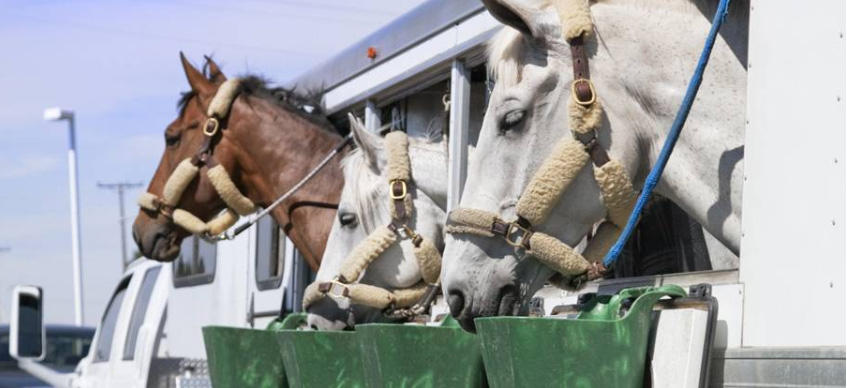
It’s a rare horse that hasn’t been transported at some time in its life. Changing owners, competing in a show, going to a trail ride, working with a trainer, and moving to and from the racetrack are all situations that require the horse to be moved, usually by float or truck but sometimes by airplane.
Most horses learn that being transported is not a big deal, but just because they accept travel with outward calm does not mean they don’t feel stress as a consequence of the experience.
Researchers have identified at least 25 different physical, psychological, and environmental components of travel that can create stress in horses.
Aside from humans, horses are the second most common creatures to be transported by air. During a long flight or extended road trip, a horse can easily lose 5% or more of its body weight. Most gain the weight back quickly if they are allowed to rest, eat, and drink after the trip.
Travel sickness, a respiratory infection, was once quite common in horses that had been transported for more than a few hours. It is less frequently diagnosed now that owners have learned that horses should be allowed to lower their heads as they travel.
This posture allows natural drainage of fluids, dust, and bacteria from the respiratory passages, minimizing the risk of infection. Even if horses travel with their heads unrestricted, they should be watched for signs of respiratory disease for a day or two after arriving at their destination.
Some amount of dehydration is hard to prevent, even if water is offered at intervals. Horses often just won’t drink during transport or at rest stops. If a horse refuses to drink at the beginning of a rest stop, water should continue to be offered at intervals throughout the break.
Bringing water from home and offering it with a flavoring agent such as Drink-Up™ in a familiar bucket may get better results. When horses refuse to drink, it can be very frustrating for owners and can lead to dehydration.
KER Drink-Up is a scientifically formulated, highly palatable blend of ingredients that encourages horses to drink. Field studies have shown that 90% of horses offered Drink Up increased their water intake. Drink-Up includes electrolytes to help further stimulate the thirst response.
Encouraging your horse to drink enough water when traveling, competing, or during an illness is crucial in preventing dehydration and associated effects on the horse. Drink-Up is an essential tool for encouraging your horse to drink to the bottom of the bucket.
At the end of the trip, horses should be unloaded, examined for signs of illness or injury, and then allowed to rest in a stable or paddock for several hours. A half-hour of hand-walking and grazing will help horses stretch and relax before they are put in stables or yards.
Owners should provide plenty of hay and water and should watch for normal intake and also manure production. Grain can be offered after a few hours, with several smaller meals being preferable to large grain feeds. If a horse refuses to eat or drink, doesn’t pass manure within two or three hours, or shows signs of illness or discomfort, a veterinarian should be consulted.
It may take horses several days to regain lost weight and fluids after an extended trip. Signs of illness also might not be seen immediately, so horses should be checked for normal temperature, pulse, and respiration for a day or two following travel.
Reprinted courtesy of Kentucky Equine Research. Kentucky Equine Research is an international equine nutrition, research, and consultation company serving horse owners and the feed industry.
Our goals are to advance the industry's knowledge of equine nutrition and exercise physiology, apply that knowledge to produce healthier, more athletic horses, and support the nutritional care of all horses throughout their lives. Learn more at Kentucky Equine Research.
There a more informative articles in our section on Health & Education. While you're here be sure to visit our Curated Amazon Store.
- Be Pro-active Rather than Reactive with Biosecurity
- Is Your Horse Happy?
- Setting Up Thoroughbreds for Success One Stride at a Time
- Five Things About Joint Care
- The Efficacy of Sponge Baths and Hosing on Exercise Recovery in Thoroughbred Horses
- Smarter Grazing: How Satellite Technology Supports Sustainable Horse Pasture Management
- Managing Energy and Motivation While Caring for Your Horses
- Five Tips for Hiring a Horse Shipper
- Tall Fescue Toxicity in Mares
- Healthy Joints for Years of Happy Trails
- $20,000 in student scholarships offered by Purina Animal Nutrition
- Saddle Fit Differences Between Men and Women
- Use of Standardized Exercise Tests in Equine Research
- Helping all horses live healthier lives
- 5 Tips For Keeping Aged Horses Fit To Compete
- Fruits are Fabulous, even for Insulin Resistant Horses!
- 12 Tips for Being a Good Member of Your Boarding Barn
- $10,000 Equestrian Merit Scholarship
- Non-GMO is NOT Necessarily Safe
- Consider Beet Pulp Instead of Oats