




Health & Education
We all want the best care possible for our horses. The Heath & Education section covers both Learning Institutions, Organizations as well as many sources for equine assistance including Veterinarians and Farriers.
For those who want a to formally study horses, the Education section includes College Riding, Equine Studies, and Veterinary Schools. Learn about the wide variety of horses in the Horse Breeds section. Supplements and Treatments Therapy are also included in the section.
Everyone can learn from Fine Art and there are some specialty Museums that might surprise you.
Horses as a therapy partner enrich the lives of the disabled. These facilities are listed in our Therapeutic Riding section. To help children and young adults build confidence and grow emotionally, please see the resources available on the Youth Outreach page.
Looking for a place to keep your horse? You can find it in the Horse Boarding section. Traveling? Find a Shipping company or Horse Sitting service if your horse is staying home!
Want to stay up to date with the latest training clinics or professional conferences? Take a look at our Calendar of Events for Health & Education for the dates and locations of upcoming events.
Do we need to add more? Please use the useful feedback link and let us know!
By Kentucky Equine Research Staff
It’s green; it’s grass; it’s good. This may be the approach of some horse owners when it comes to pasture forage, but savvy broodmare managers know differently.
One forage taunts broodmare managers in some parts of the United States so mercilessly that many consider it a weed, even a noxious one. In many ways, their assessment is just. Can you name the pasture plant?
Did you guess tall fescue, specifically toxic endophyte-infected tall fescue? If you did, you are correct!
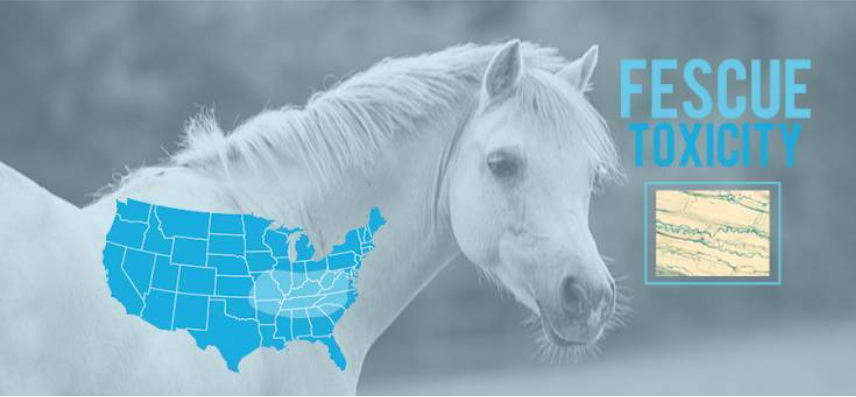
Tall fescue (Festuca arundinacea) is a productive, persistent cool-season grass. Most existing stands of tall fescue in the United States occur in a particular region called the “Fescue Belt.” In the east, the Fescue Belt runs from mid-Georgia north to Pennsylvania, and to the west it runs from Oklahoma to Kansas.
In the case of tall fescue, a particular fungus (Neotyphodium coenophialum) called an endophyte grows within the plant between the plant cells. Because it proliferates internally, visible signs of the infection cannot be seen with the naked eye.
The endophyte concentrates in the seeds as well as plant parts closest to the ground. The predominant alkaloid, or by-product, of this endophyte, is ergovaline. Because pastures are dynamic, growing and receding with weather changes, ergovaline levels rise and fall during the year. Research has revealed that ergovaline generally peaks in May and September, but levels are high enough to cause problems in pregnant mares throughout much of the growing season.
In addition to pasture, mares consuming hay containing endophyte-infected tall fescue are susceptible to toxicity, as are mares that are bedded on similar hay.
If pregnant mares have access to endophyte-infected tall fescue, they are likely to show signs of tall fescue toxicity, characterized by prolonged gestation, difficulty foaling, thickened placenta (including premature separation of the placenta known as a “red bag” presentation), decreased or absence of milk production, weak or dead foals, and reduced breeding efficiency following parturition.
Plant breeders successfully extracted the endophyte from tall fescue, but it left the plant less vigorous. As it turns out, the endophyte gives tall fescue some of its most admired qualities, including top-drawer pest resistance and stress tolerance (drought, heat, grazing pressure). Because of this diminished persistence, endophyte-free tall fescue has little use in real-world pasture situations.
Most recently, plant breeders introduced novel or beneficial endophyte tall fescue. While these new varieties contain endophyte, it does not produce alkaloids, so it causes no toxicosis and has many advantageous characteristics, especially excellent persistence.
To determine the endophyte status of existing stands of tall fescue, laboratory testing is necessary. Consult a pasture specialist or university extension personnel for help with this.
While pasture renovation is the ideal solution to endophyte-infected tall fescue stands, other strategies can help keep mares safe. The primary mitigation strategy is removal of mares from toxic fescue 30-90 days before foaling. If no other grazing areas are available, revamp the diet to include high-quality hay or alternative forages (hay cubes, hay pellets, etc.) as the principal forage sources.
Oral administration of domperidone 10 to 20 days before expected foaling can prevent the signs of fescue toxicosis in pregnant mares. In one study, domperidone administered to 1,423 mares in the United States under veterinarian supervision and under field conditions was 95% effective in preventing signs of tall fescue toxicosis.
Image information: The highlighted area on the United States map shows the region where tall fescue is dominant and widely used in forage stands, and to which the term “Fescue Belt” typically applies (Ball et al., 2019). Within the blue square is a microscopic view of the tall fescue endophyte within the plant. Photograph by Carolyn Young, Ph.D., North Carolina State University.
*Poore, M. 2017. Tall fescue: Wonder grass or toxic curse. North Carolina State University Extension. Accessed February 3, 2025.
Other references:
Ball, D.M., G.D. Lacefield, and C.S. Hoveland. 2019. The wonder grass: The story of tall fescue in the United States. Oregon Tall Fescue Commission.
Roberts, C., and J. Andrae. 2022. Fescue toxicosis and management, 2nd ed. American Society of Agronomy, Inc., and Crop Science Society of America.
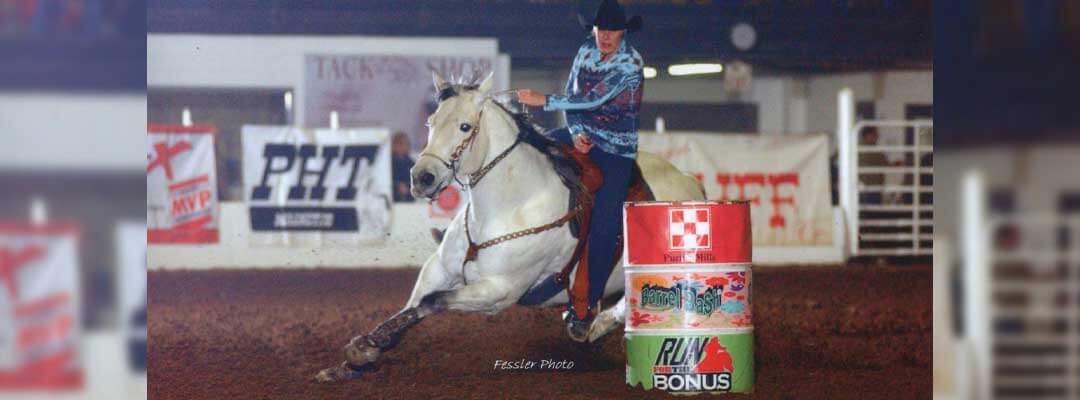
As a lifelong barrel racer, Kansas City's Tina Svoboda has traveled all across the Midwest with her Quarter Horse mare, Cee that Booger, whom she fondly calls Bella. With their time on the road, and years owning horses alongside her husband Jim, Tina has witnessed her fair share of joint health problems.
Joint issues can impact all horses, ages and disciplines. And the severity can range from minor to career ending.
"The horses I've known with joint problems have all retired early or were otherwise forced to change careers," Tina said. "To help prevent joint problems, we started Bella as a 4 year old on Adequan Equine. She's 12 now and is the first horse we've had that has never had joint issues."
Adequan Equine is FDA-approved and proven to diminish the destructive processes of degenerative joint disease, while reversing the loss of cartilage components and improving the overall joint health for horses. Heathy cartilage is crucial to the performance of a horse's joints. Using Adequan Equine, new cartilage is quickly produced and any inflammation is decreased.
"When you've had a number of consecutive horses and barrel horses, joint issues are a common occurrence," Tina said. "Bella is the first who hasn't, and I attribute that to introducing her to Adequan Equine early on in her life."
Help horses avoid joint problems by:
- Incorporating a joint health supplement like Cosequin to help maintain joints and cartilage
- Prioritizing hoof care and keeping horses on a regular trim schedule
- Keeping horses at optimum weight and avoiding obesity, which stresses the joints
- Offering quality nutrition for strong bones and healthy cartilage
- Riding on softer footing and limiting work on hard surfaces
- Using Adequan Equine to help prevent and repair joint problems
- Using Equioxx, which is often prescribed by veterinarians for joint pain relief, as well.
- "Adequan Equine has a really good reputation for working on horses, regardless of their discipline," Tina said.
Tina purchased Bella as a green-broke filly, and now riding together for more than eight years, the pair recently switched gears from running the barrel pattern to competing in AQHA ranch riding. "She's one in a million," Tina said, referring to her stunningly versatile grey mare. "Not many horses could have made the transition from a barrel horse to an arena horse so easily. She's willing to try whatever you can do. She's phenomenal."
All photos courtesy of Valley Vet.
This article originally appeared on Valley Vet and is published here with permission.
There are more informative articles in our section on Health & Education. Be sure to check out our Curated Amazon Store for Feed, Supplements and Horse Farm supplies.
- $20,000 in student scholarships offered by Purina Animal Nutrition
- Saddle Fit Differences Between Men and Women
- Use of Standardized Exercise Tests in Equine Research
- Helping all horses live healthier lives
- 5 Tips For Keeping Aged Horses Fit To Compete
- Fruits are Fabulous, even for Insulin Resistant Horses!
- 12 Tips for Being a Good Member of Your Boarding Barn
- $10,000 Equestrian Merit Scholarship
- Non-GMO is NOT Necessarily Safe
- Consider Beet Pulp Instead of Oats
- Five Tips About Dummy Foals
- The Role of Nutrition in Managing Muscle Disorders
- Secrets of Successful Riding Instructors
- Horse Veterinarians in Alabama
- Horse Veterinarians in Alaska
- Horse Veterinarians in Arizona
- Horse Vet in Arkansas
- Horse Veterinarians in California
- Horse Veterinarians in Colorado
- Horse Veterinarians in Connecticut