




Health & Education
We all want the best care possible for our horses. The Heath & Education section covers both Learning Institutions, Organizations as well as many sources for equine assistance including Veterinarians and Farriers.
For those who want a to formally study horses, the Education section includes College Riding, Equine Studies, and Veterinary Schools. Learn about the wide variety of horses in the Horse Breeds section. Supplements and Treatments Therapy are also included in the section.
Everyone can learn from Fine Art and there are some specialty Museums that might surprise you.
Horses as a therapy partner enrich the lives of the disabled. These facilities are listed in our Therapeutic Riding section. To help children and young adults build confidence and grow emotionally, please see the resources available on the Youth Outreach page.
Looking for a place to keep your horse? You can find it in the Horse Boarding section. Traveling? Find a Shipping company or Horse Sitting service if your horse is staying home!
Want to stay up to date with the latest training clinics or professional conferences? Take a look at our Calendar of Events for Health & Education for the dates and locations of upcoming events.
Do we need to add more? Please use the useful feedback link and let us know!
by Kentucky Equine Research Staff
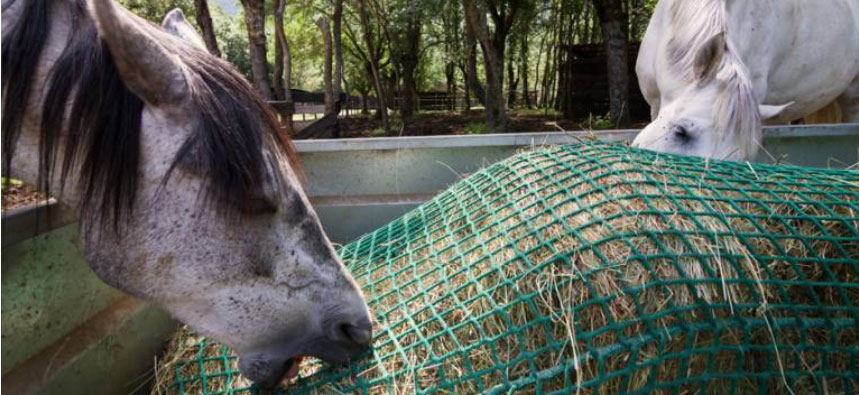
Hay nets and slow feeders offer clear health, welfare, management, and economic benefits but in some cases can create behavioral and musculoskeletal concerns. These management tools must be appropriately implemented to avoid introducing risks.
Researchers reached this conclusion after reviewing 23 studies on hay nets and slow feeders performed between 2009 and 2025.* Those studies looked at the effect of hay nets and slow feeders on feeding behavior, welfare, and health outcomes. Hay nets refer to devices that feature various hole sizes that are hung from a stationary object, such as a stall wall, while slow feeders typically rest on the ground with small- to medium-sized openings.
“Hay nets and slow feeders have become increasingly popular to address welfare concerns associated with feeding. Such concerns include extending feeding times to mimic the natural grazing schedule of feral horses, gastric disorders, and metabolic diseases. Reducing forage waste is another reason these tools are used by horse owners,” explained Kathleen Crandell, Ph.D., a Kentucky Equine Research nutritionist.
Despite being popular for those reasons, scientific evidence supporting hay nets and slow feeders for these purposes is not consistent. A team of veterinary researchers conducted a comprehensive review of the literature to evaluate the effect of hay nets and slow feeders on feeding time, behavior, and forage and health management.
Although more data were available for hay nets than slow feeders, both showed beneficial effects.
Hay nets and slow feeders extend feeding times, benefiting gastric health.
Read more: Hay Nets and Slow Feeders for Horses: Pros and Cons
by Kentucky Equine Research Staff
Spring promises more time to groom, to ride, to deepen relationships with horses. Despite these advantages, this season of renewal can trigger diet-related health glitches for certain horses.
“The flush of spring grass is often a welcome change for owners of senior horses or hard keepers struggling to maintain body condition on hay-based rations,” said Catherine Whitehouse, M.S., a nutrition advisor with Kentucky Equine Research.
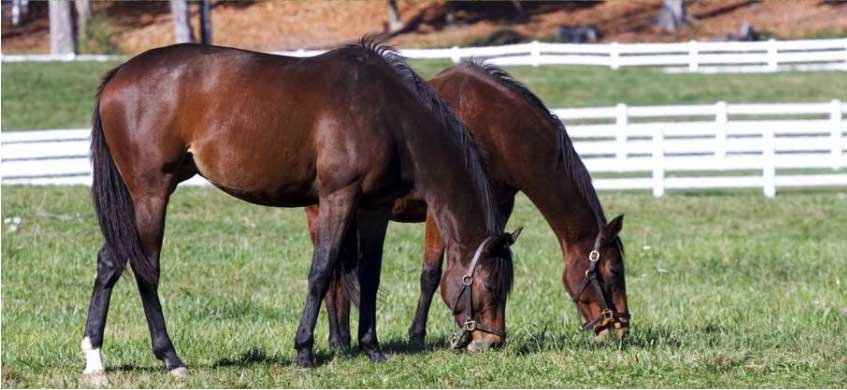
Because of the unmatched palatability and low dry matter content of fresh grass, horses can consume large amounts, sometimes up to 5% of their body weight daily. For a 1,000-lb (450-kg) horse, that’s 50 lb (23 kg) of grass every day.
Several classes of horses thrive on good-quality pasture, such as pregnant and lactating mares, growing horses, and senior horses. Compared to hay, the higher energy content and shorter fiber length of pasture is especially beneficial to senior horses that cannot maintain condition on hay-based diets.
While some horses can graze pastures without worry of excessive weight gain, others cannot. Overconsumption of grass can be problematic. Strategies to slow pasture intake include using a grazing muzzle, restricting the amount of time on pasture, and feeding hay before turnout.
“Grazing muzzles are a great tool for owners, but grass intake levels can be highly variable,” Whitehouse said. “For some horses, grazing muzzles are not restrictive enough. Providing time each day without access to pasture—but with appropriate hay—plus the use of a grazing muzzle during grazing hours is best for managing easy keepers.”
Keeping a close eye on the weather forecast can also be helpful. Drastic temperature changes between day and night influences the sugar content of grasses. Sugar-sensitive horses should be kept off stressed pastures, such as those subjected to frost or drought. During the growing season, studies suggest that the best time to graze these horses is after midnight and before 10:00 a.m. when sugar content is lowest.
Potential digestive issues associated with grazing lush pastures include loose manure, gassiness, and colic.
As dormant pastures turn green, special consideration should be given to horses that have been managed throughout the winter with limited turnout, such as those kept primarily in stalls or drylots.
“These horses should be introduced slowly to pasture because, unlike a horse on pasture 24/7, they do not have the advantage of gradual adaptation to pasture availability and changes in nutrient composition,” Whitehouse advised. “Reintroducing horses to grazing during the spring should be approached cautiously to allow the microbial population of the hindgut to adapt to changes in forage, particularly higher levels of rapidly fermentable fiber and nonstructural carbohydrates.”
Recommendations for acclimation to turnout vary, but one safe method would be to increase turnout time by 30-40 minutes daily until the horse reaches its full turnout time.
“Owners of easy keepers and horses with endocrine conditions, such as pituitary pars intermedia dysfunction (PPID) or equine metabolic syndrome (EMS), may not be as pleased with spring’s bounty,” Whitehouse said, “because they must become more vigilant in their management routine.”
For metabolic horses with insulin dysregulation, a core feature of EMS, careful management to restrict intake of cool-season pastures is necessary to prevent pasture-associated laminitis. These horses vary significantly in how much they can graze safely. Some do well when allowed to graze with a muzzle for part of the day and fed hay the remainder of the day. Others, though, cannot graze at all and must be kept in drylots with appropriate hay.
Horses maintained in drylots require supplemental hay year-round, and the hay should be carefully selected to match the energy needs of individuals. Sedentary easy keepers, for example, might do well on mature grass hay, while those with higher energy needs, such as performance horses in light or moderate work, may benefit from high-quality grass hay or mixed grass-alfalfa hay. Fortified feeds should be selected to provide appropriate amounts of nutrients to balance the diet when fed at the recommended intake.
Horses in drylots without access to pasture are candidates for vitamin E supplementation beyond that found in fortified feeds. Vitamin E levels in hay are significantly less than in fresh forage, so vitamin E status of horses fed only preserved forages can diminish over time. Supplemental vitamin E in a highly bioavailable form, such as Nano-E, is necessary to support optimal health in all horses, but is especially significant in exercising horses.
Free-choice access to salt should always be available, but horses grazing lush pastures may benefit from receiving salt top-dressed onto their feed to ensure adequate sodium intake and to encourage drinking.
A digestive buffer such as EquiShure is recommended for all horses, as it can help mitigate the negative effects of a sudden influx of fermentable fibers into the hindgut. EquiShure helps maintain a neutral pH by buffering excessive acid in the hindgut, thereby supporting a healthy microbial population.
There a more informative articles in our section on Health & Education. While you're here be sure to visit our Curated Amazon Store.
Are you interested in promoting your business or sharing content on EIE? Contact us at info@equineinfoexchange.com
- What is the Average Horse Size? Which Horses Were the Tallest & Smallest?
- What are the Top 5 Most Popular Horse Breeds?
- What is the Lifespan of a Horse and Which Horse Breeds Live the Longest?
- How to Identify Horse Breeds!
- Are Donkeys Good Horse Companions? Learn More!
- The Essential Horse Care Tips
- Tips to Keep Horses Safe in Ice and Snow
- Adjusting Horse Diets in Winter: Is It Necessary?
- The Impact of Light on Horse Reproduction With Dr. Barbara Murphy
- The Overweight Horse – A New Year’s Resolution
- Survey Reveals Emotional and Practical Challenges in Managing Horse Weight
- Why Did My Horse Just Do That?
- Staying Warm This Winter - WSI Sportswear at Equine Affaire 2025
- A Guide for Livestock and Equine Grooming
- How Feeding Routine, Age and Workload Affect Joint Supplement Needs
- Vitamin E Requirements and Testing Recommendations in Horses
- Semican Horse Feed at Equine Affaire 2025
- CBD and other Cannabinoids – How they can benefit you, your horses, and your pets
- Causes of Death in Retirement Facilities for Horses
- "Purina" at Equine Affaire 2025